



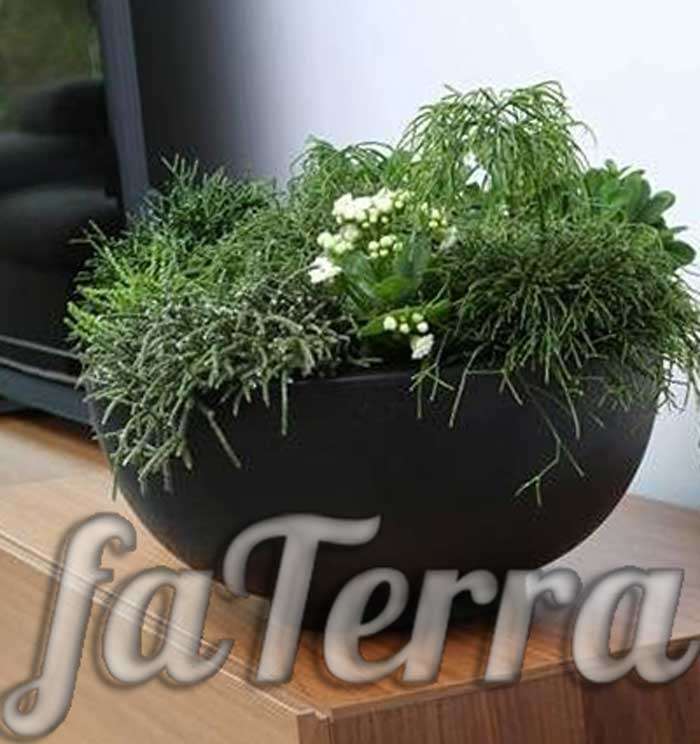
Latin name: (Rhipsalis)
Category: herbaceous epiphytic shrubs
Origin: America, Africa, South Asia
Unique Rhipsalis
The absence of thorns on Rhipsalis does not prevent it from occupying a prominent place in the cactus family. The Rhipsalis genus consists of about fifty varieties of the oldest epiphytic cacti, which were studied by botanists and were among the first to appear in indoor floriculture. It can be noticed that florists' acquaintance with Rhipsalis is less fruitful than with its closest relatives, Schlumbergera and Hatiora.
The Rhipsalis plant is commonly called "prutovnik" (rod-like plant). The botanical name of the Rhipsalis plant comes from the word "rhips," which translates from Greek as "weaving" or "twisting."
The Rhipsalis cactus considers its homeland to be the humid tropical jungles of America and Africa. South Asia and the islands of the Indian Ocean have suitable climates with warm rains for forest cacti. This was facilitated by migratory birds. The crowns of trees or rocky outcrops are a suitable soil where the Rhipsalis succulent feels great.
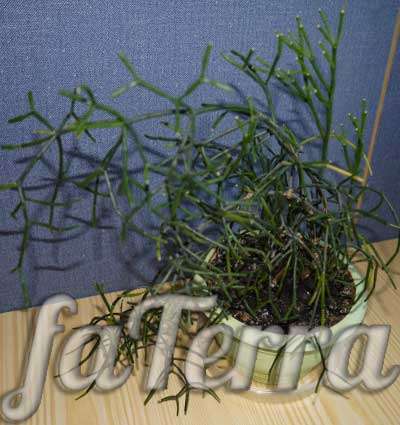
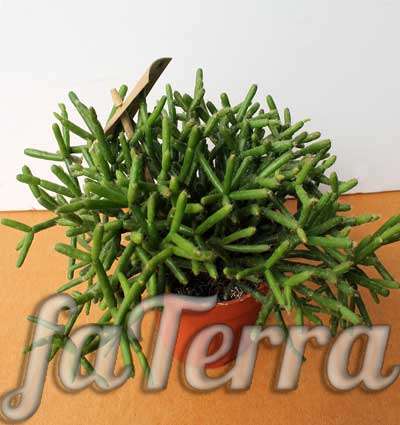
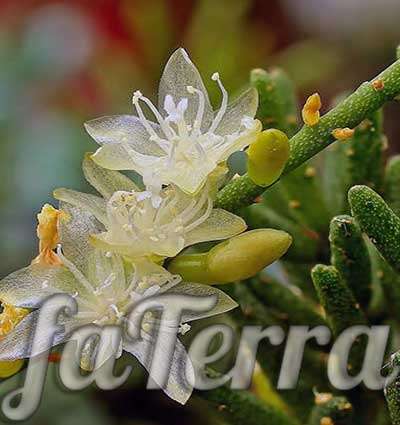
Description of Rhipsalis: its thin, cylindrical, star-shaped, or flat greenish stems consist of elongated, branched segments of varying lengths, forming bushes that enjoy the dim light created by large trees. During the autumn-winter period, Rhipsalis blooms with small white or yellowish flowers. The entire length of the stem and its tip can be the location of flowers, which then turn into juicy fruits that resemble gooseberries.
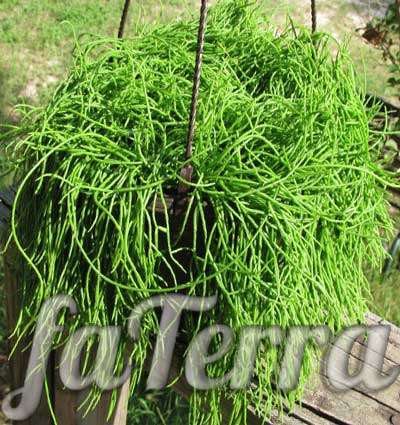
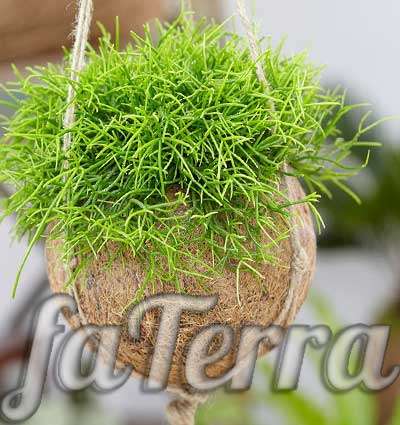
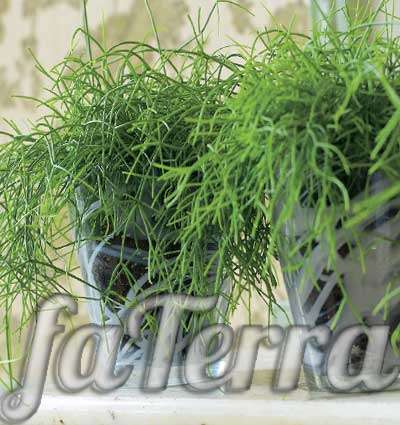
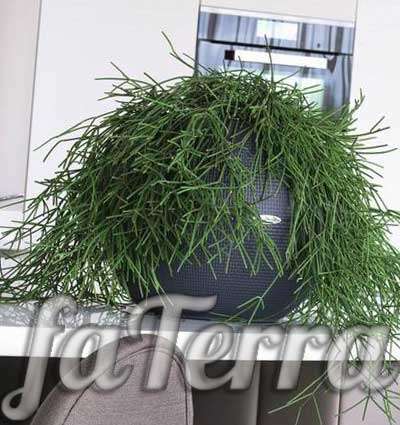
Rhipsalis will look original as an ampelous plant in hanging pots or baskets. Good companions for it will be Tradescantia, Chlorophytum, or Begonia.
Rhipsalis species
Rhipsalis cereuscula
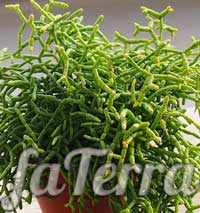 Also known as cereus-like or candle-like, it originates from Brazil, Argentina, and Uruguay and is widely cultivated.
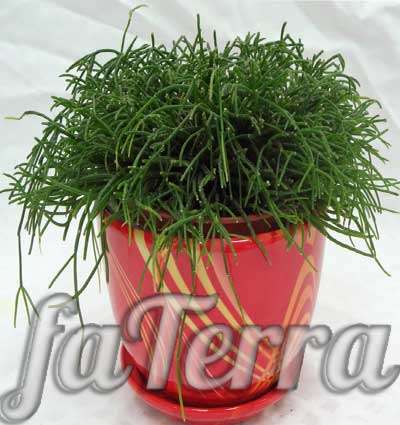
Indoor Rhipsalis cereuscula plants with strongly branched, arcuate stems form dense, lace-like, perennial bushes up to sixty centimeters high. Flowering of Rhipsalis in indoor conditions is a very rare phenomenon. Sometimes you can admire two-centimeter white flowers.
Rhipsalis cassutha
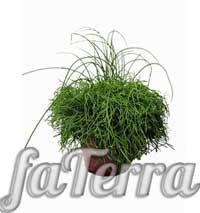 It belongs to the non-fruiting species and is the most common among flower growers. Rhipsalis cassutha is grown in wall pots. Its stems are thin and segmented, and can grow up to 3 meters in length.
The cactus is quite decorative with its chaotically curly greenery. Creamy flowers bloom profusely along the entire length of the stems and cover the entire bush. Reddish berries soon form in place of the buds.
Rhipsalis pilocarpa
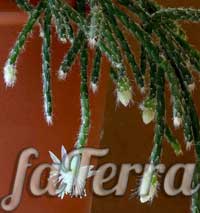 Unlike Rhipsalis cereuscula, this variety has much larger and less branched shoots with drooping yellowish hairs. How does this species of Rhipsalis bloom?
If you bring the indoor growing conditions closer to natural, you can observe this unusual sight up to three times a year. Large, twenty-millimeter, whitish-yellow flowers with numerous petals and stamens cover the indoor Rhipsalis flower. A pleasant, strong aroma spreads throughout the area around the plant. After flowering, round, one-centimeter berries can form on the pollinated stem, which look great and decorate it.
Rhipsalis capilliformis
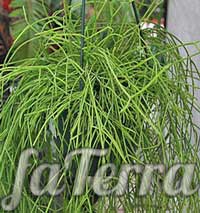 An elegant ampelous succulent plant with long, more than one meter, thin, soft, and densely branched stems. Very small white flowers appear on the lush bush.
Rhipsalis crispata
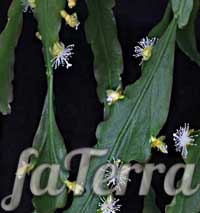 A bushy, beautiful succulent with drooping, dense stems, which are formed by flat, elongated segments up to ten centimeters long. Outwardly, Rhipsalis crispata is similar to a Christmas cactus. Small, creamy flowers on each segment of the stem make it charming.
Rhipsalis mesembryanthemoides
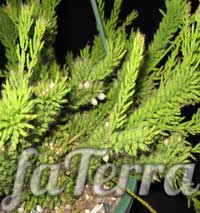 A very interesting and attractive cactus-epiphyte from the tropics of Brazil. On the main, strong, elongated, cylindrical, woody, twenty-centimeter shoots of light green color, secondary short branches and a huge number of aerial roots are located. Together, they resemble a Christmas tree branch. Mesembryanthemoides Rhipsalis is a flowering plant. It is especially beautiful and original when white flowers appear.
Rhipsalis Russellii
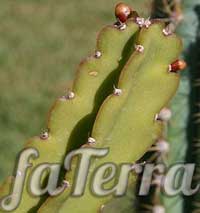 A special charm and extraordinary elegance emanate from the small, bright yellow flowers and pink bead-like berries, located along the entire length of the meter-long shoots, which consist of wide, flat segments.
Rhipsalis lidbergiana
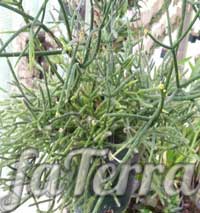 A characteristic feature of this species is the thin, five-millimeter stems, which have the shape of sticks and can reach a length of two meters. Secondary segments are much shorter. The delicate pink flowers are small.
Rhipsalis burchellii
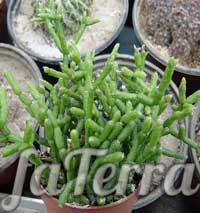 The forest epiphytic exotic is called "coral" in common parlance. Small, five-centimeter segments are arranged in thin, rounded stems in cross-section, which grow up to half a meter. Small yellowish flowers appear at the ends of the shoots. The Rhipsalis flower will look great both in hanging pots and on stands.
Rhipsalis flower care in the home
Rhipsalis, an indoor flower, is considered absolutely unpretentious, but it has certain requirements. The forest cactus needs to be watered and fed in time, create a comfortable temperature, provide adequate lighting, and, of course, a little love. Now let's take a closer look at how to care for the Rhipsalis plant?
Lighting and temperature regime
A windowsill facing east or west will be comfortable for a forest dweller. On the south side, it is necessary to shade the plant from bright sunlight. The northern areas will negatively affect the growth of the shoots and the absence of flowering.
A comfortable summer temperature is 18-25°C, and in winter - 15-17°C. In a cool place, the plant will rest well and prepare for intensive growth and abundant flowering. Lower temperatures of 10°C are possible, but it is not advisable to abuse these parameters.
Watering and air humidity
Rhipsalis, an indoor flower, should be watered with settled water at room temperature. We regulate the intervals between waterings with slightly dried substrate in the pot by one-third of its volume. If, during the rest period, Rhipsalis is kept in a cool environment, then it should be watered less often.
High humidity in the air will be comfortable for the forest cactus. You can use a spray bottle to spray it every three days or give the plant a warm shower.
Feeding Rhipsalis
During the warm period, it is desirable to feed the Rhipsalis succulent every two weeks. Special mineral complexes for cacti and succulent plants, as well as for flowering plants, with a small amount of nitrogen, will be suitable for the rod-like plant. During the cold off-season, Rhipsalis succulent does not need to be fed.
Soil
The indoor Rhipsalis flower adapts well to a soil mixture with a neutral acidity, good water and air permeability. A mixture of equal parts of leaf soil, sod, coarse sand, and peat will be an excellent option. Ready-made soil in which succulents feel great is sold in the store.
Propagation and transplanting of Rhipsalis
- Rhipsalis can be easily and effectively propagated by cuttings. Break off a piece of stem of medium age with several segments from the plant. Plant the dried stem in moist peat-sand mixture. You can create a mini-greenhouse environment and a temperature of 22-25°C.
- Propagation of Rhipsalis by seeds is much less common than the previous method. If desired, you can sow the seeds in moist soil. Seedlings that have grown and strengthened should be transplanted into a separate pot in a permanent place. Be sure to maintain a temperature of 22-25°C.
- You can propagate the rod-like plant by dividing the bush into parts.
Transplant Rhipsalis according to age category.
Young cacti should be repotted annually, more mature plants - every three years, and subsequent repotting - every five years.
We transplant the indoor plant into wide and not very deep pots. A good layer of drainage is required at the bottom. Then we transplant the seedling into a new pot, add soil.
Pests and diseases of Rhipsalis
Mealybugs or scale insects can attack the fleshy stems of the indoor flower. In case of partial damage to the plant, a folk method of control should be used: onion, garlic, or tobacco infusion. If these procedures are not enough, use chemical preparations.
Difficulties in growing
- Why does Rhipsalis not bloom? The plant lacks light, irregular watering, and insufficient nutrient soil.
- Rhipsalis sheds leaves and buds - the plant should not be moved from one place to another.
- The stems turn pale and become flabby - root rot has appeared, and there may be pest damage.
Write comments
Comments