



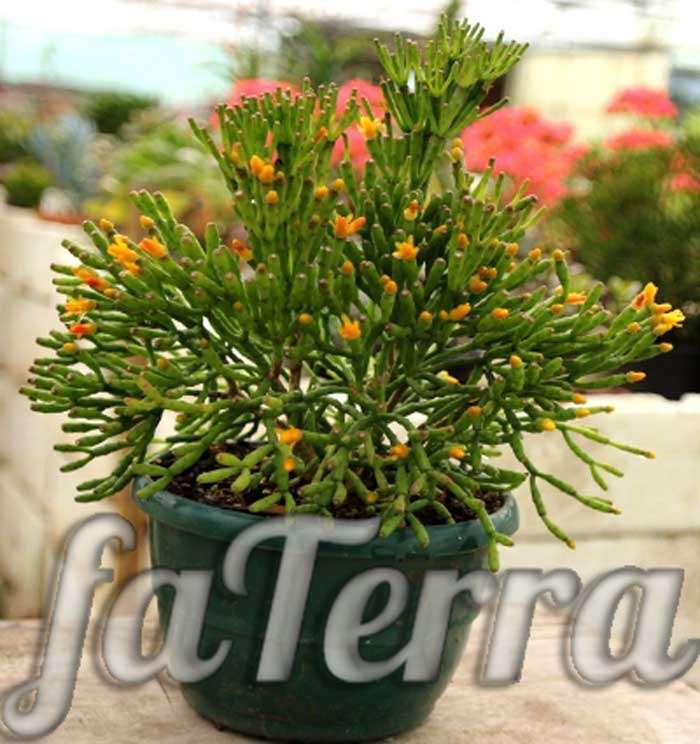
Latin name: (Hatiora)
Category: herbaceous perennial vines, epiphytic cactus
Origin: Argentina, Brazil, Uruguay
Hatiora – the dancing bones cactus
Hatiora is a small genus, with about ten species of interesting succulent perennials, with an epiphytic or lithophytic growth habit, in the Cactus family. But the hatiora has absolutely no resemblance to a cactus.
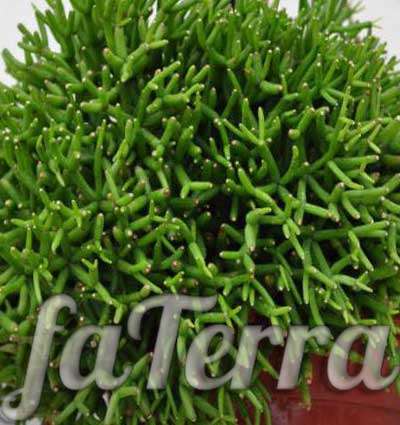
The question of why the leaves of indoor plants turn yellow in this case is not relevant. After all, hatiora does not have leaves, nor does it have thorns. These unusual plants, about forty centimeters high, have thornless shoots in the form of cylindrical branches of three-centimeter segments, which form various whimsical shapes. They can be compared to bones, small bottles, corals, seaweed, or amazing marine animals.
It is because of its appearance that the hatiora flower is popularly called the "dancing bones cactus." Other not very correct names for the coral-like flower are: "drunkard's dream," "male tears," "spicy cactus."
The humid forests with a tropical climate of Brazil, Argentina, and Uruguay are the homeland of hatiora.
The English scholar and traveler Thomas Harriot, a researcher of American flora and a cartographer from the sixteenth century, became the symbol of the name of the unusual hatiora cactus. Such a name already existed in the plant world, so it was decided to change it by means of an anagram. Thus, the original and beautiful flower, similar to coral, became hatiora from harriota.
Hatiora species
Hatiora salicornioides
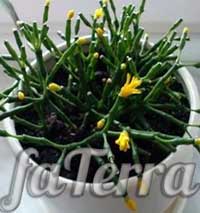 This is a typical variety of the hatiora genus, which is widely cultivated in home conditions.
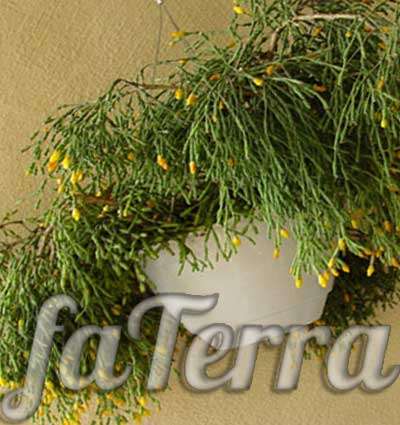
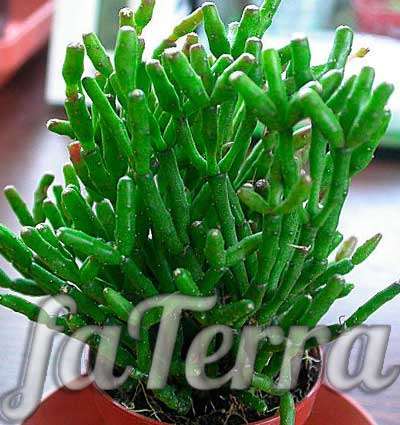
Wild hatiora is found in the Brazilian tropical forests. It is also called hatiora salicornioides, salerosoide, or saltwort. The height of this densely branched shrub, formed by round, thin stems, consisting of twenty-five-centimeter segments, resembling dark emerald-colored cones, is forty centimeters.
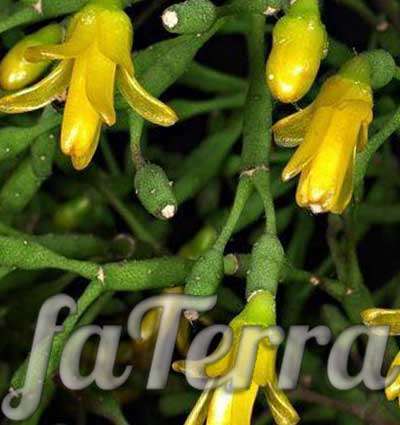
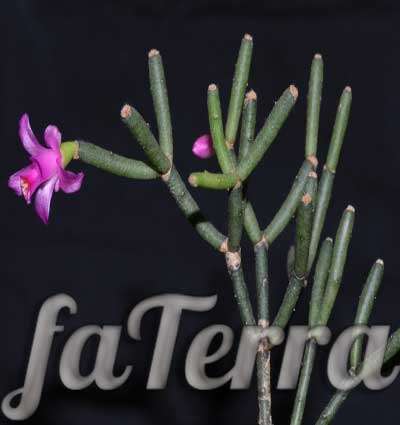
The indoor hatiora pleases with its flowering during the cold winter months until the arrival of spring warmth. A large number of small, one-centimeter, bell-shaped, solitary flowers: pink, yellow, or red, appear on the tops of the shoots. The British call it the "dancing bones cactus."
Hatiora herminiae
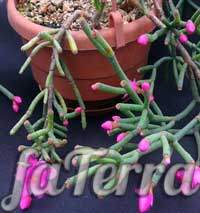 A flowering, original epiphytic cactus with thirty-centimeter, straight or arc-shaped, dark green shoots. They are formed by elongated, five-centimeter cylindrical segments. The rich raspberry color of the small, two-centimeter flowers gives the flower an indescribable and unique beauty.
Hatiora pentaptera
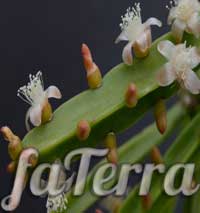 The pentagonal ribbed stems of this cactus create a small shrub. The decoration of the plant is small white flowers.
Hatiora gaertneri
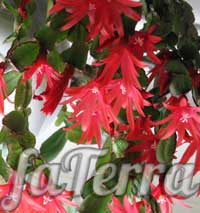 The plant has dark green, drooping stems. They are made up of flat, oval-shaped segments, reaching seven centimeters in length, with scalloped edges. The tops of the stems and the places of articulation are decorated with bright pink flowers, up to five centimeters long. This widely cultivated decorative succulent cactus can be easily mistaken for a schlumbergera (Decemberist). The difference between them is in the shape of the flower, because in the Decemberist it is zygomorphic. Its symmetry can be determined by the perianth. The stems of hatiora and ripsalis are very similar.
Hatiora rosea
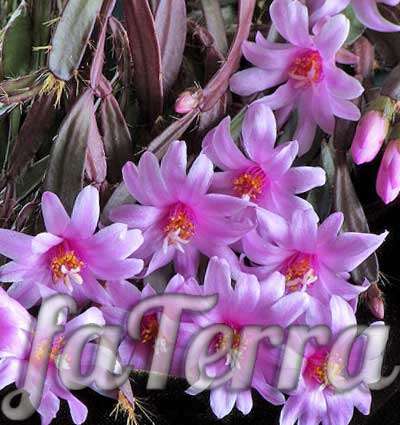
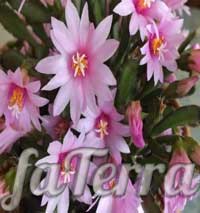 The hatiora plant looks like a compact bush. Drooping, green stems with a reddish tint are made up of small segments with ribbed edges. The length of each is up to two and a half centimeters. The flowers are pink with a raspberry hue, and their diameter reaches four centimeters.
Caring for hatiora at home
Hatiora care is not difficult, as it is an absolutely unpretentious plant, and depends on the time of year. After all, the flowering hatiora desires quality care during the winter period to obtain a bright, lushly flowering bush.
Choosing a place and lighting
Indoor hatiora prefers to be in places with intense diffused light. The best places are the west and east sides. The north windowsill is less suitable for the plant, and if the plant is not illuminated with fluorescent lamps, the flowering will be less abundant. The south location requires protection of the flower from the midday sun.
Temperature and humidity
It is necessary to pay special attention to this indicator, as it is directly related to the quality of flowering and the condition of the plant segments. In summer, the temperature should be maintained at 17-25˚C. In autumn, the temperature drops to 11-15˚C and is maintained until abundant and prolonged flowering.
For the hatiora flower, a humidity of about 40% is sufficient. If the above temperature limits increase, it is desirable to spray the plant. It is not necessary to place the indoor spicy cactus near the heating system. This will negatively affect the quality of flowering.
Watering
During the period of active growth and flowering, indoor hatiora should be watered abundantly with warm, settled water. A regulator can be slightly dried soil in the pot. In winter, water infrequently, and during the period of rest of the plant, watering can be temporarily stopped for a month.
Fertilizer
During active growth, the "drunkard's dream" should be fed every fifteen days with complex mineral fertilizers, which do not contain calcium and have a very low nitrogen content. These can be fertilizers for flowering or cactus plants.
Transplanting and soil
It is necessary to change the pot and substrate for hatiora after the last flower falls. Young hatioras are repotted annually, more mature ones - every three years, and large plants - no more than once every five years. The pot should be taken with a drainage hole of the same height and width.
It is desirable to change the pot for indoor hatiora every five years.
A solid drainage layer is placed on the bottom of the pot, then a little soil mixture, and then the flower "male tears" is planted using the transshipment method. Add soil, and compact it well. The planted plant should be watered.
The hatiora flower will be happy with a light, breathable soil mixture. Organic peat substrate for cacti is a very good option. It is easy to prepare the soil mixture yourself. All ingredients should be taken in equal parts: sod soil, leaf soil, peat, coarse sand or perlite.
Propagating hatiora
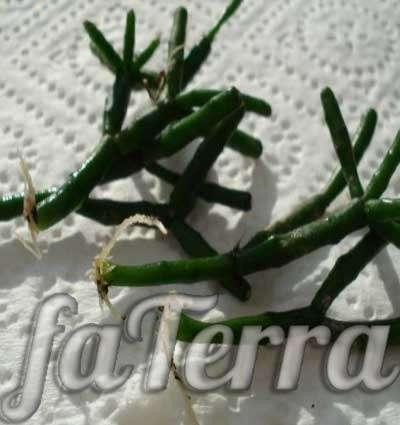
Hatiora - how to properly plant and grow an indoor plant and enjoy its flowering. It is very simple. Succulent hatiora is propagated by cuttings at any time of the year. A segment of the stem with three segments is dried for two days, and then placed in a moist mixture of sand and peat. Create a mini-greenhouse environment. With diligent care and good growing conditions, the indoor hatiora plant will delight you with bright and abundant flowering.
Diseases and pests of hatiora
The coral-like flower is strong, hardy, and resistant to attacks by pests. Sometimes, these can be scale insects, whiteflies, mealybugs, spider mites. Do not delay, and treat your indoor plant with insecticides.
Difficulties in growing hatiora
- Why does hatiora not bloom? If your indoor plant does not bloom, or it has very few flowers, then the reason is that the growing conditions are not being met. Namely, the flower lacks light, humidity, and fertile soil, which must be regularly fertilized. For abundant bud formation and lush flowering, hatiora needs to overwinter at a temperature of 10-16˚C.
- Flowers and segments fall off the flowering hatiora - lack of moisture in the soil, too low air temperature, root rot, the appearance of pests, a change in the location of the flowering succulent.
- The segments become pale and flabby - direct sunlight, visiting guests-pests, irregularity in watering.
Take care of your hatiora flower properly, love it. It will become a decoration and an integral part of any interior, both in a pot and in a hanging pot.
Write comments
Comments