



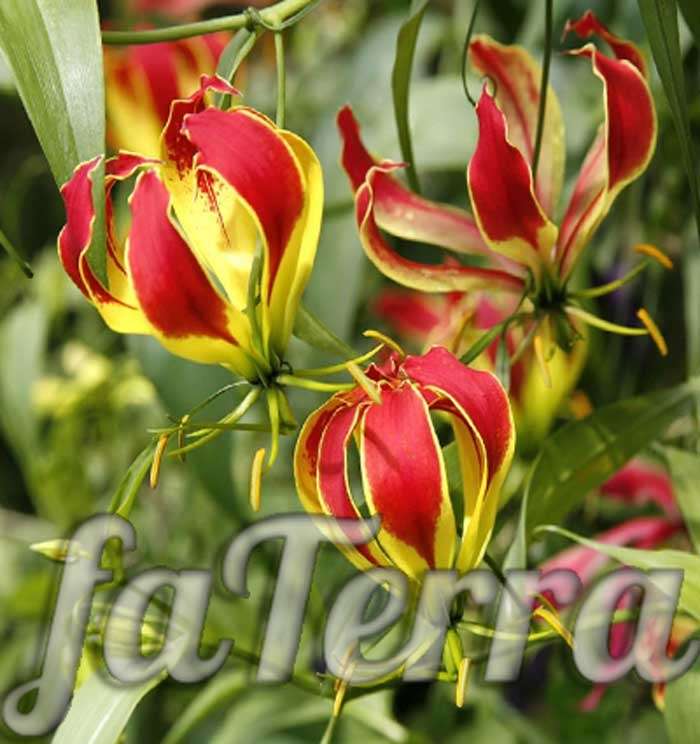
Latin name: (Gloriosa)
Category: herbaceous perennial vines
Origin: tropics of South Asia and Africa
Gloriosa – a beautiful but dangerous "lily of glory"
Gloriosa (Gloriosa) is a flexible climbing vine that reaches a height of five meters. It belongs to the Colchicaceae family. The genus of bulbous herbaceous perennials includes only five species.
The coastal tropical South African and Indian forests, as well as the Pacific coastal areas, are considered the homeland of the gloriosa lily.
The name gloriosa translates from Latin as "flower of glory," which truly reflects the splendor of this climbing beauty.
It is commonly called the lily of glory, climbing lily, or flame lily.
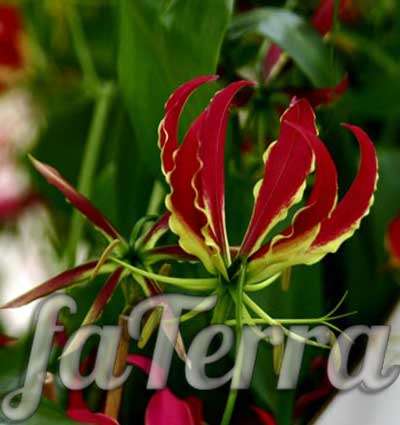
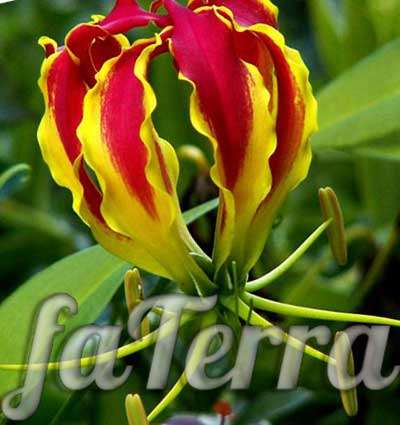
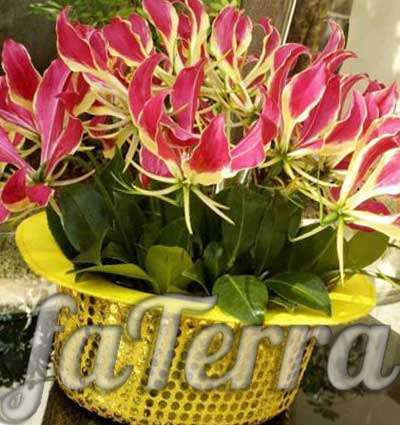
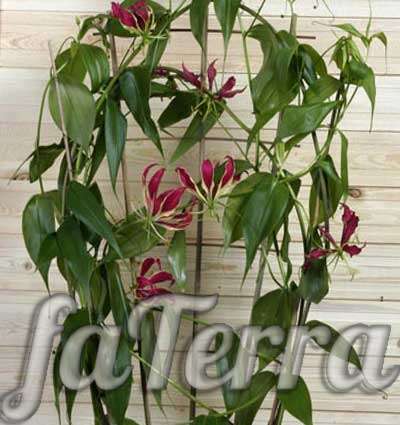
Its flowers can be compared to a Chinese lantern; they also resemble a burning torch. And the most interesting thing is that the gloriosa flower blooms throughout the summer. Each flower delights the eye with its beauty for ten days, and it is also beautiful in cut form. Florists use this. After all, gloriosa in a bouquet or in other floral arrangements is very beautiful and charming.
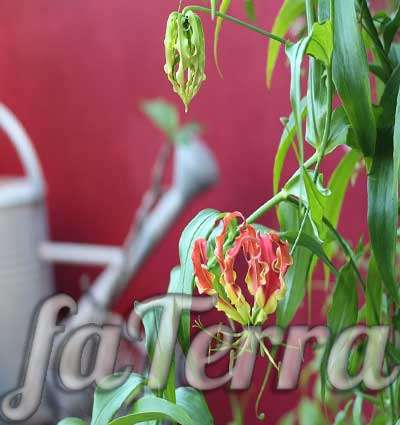
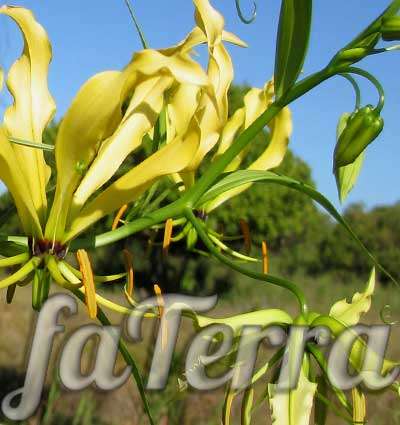
It is very interesting to observe the bright "chameleon." The powerful green buds gradually turn into orange flowers that resemble the petals of a flame, which flicker in the wind. Gradually, they turn yellow, and after a while, they become bright red. The climbing lily is adorned with its large, glossy, oval-shaped leaves of bright green color.
Gloriosa species
Gloriosa superba, also known as magnificent
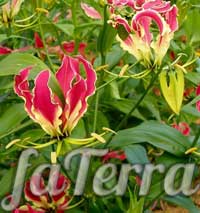 The native habitat of the most common gloriosa in home floriculture is the tropical regions of Africa, Sri Lanka, and Nepal.
On the two-meter branched stems, there are alternately arranged elegant, glossy, elongated, lanceolate leaves with curled tips-tendrils, with which the plant attaches to supports.
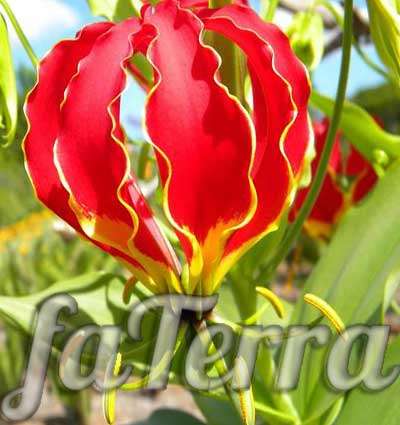
The main decoration of the indoor lily is its bright flowers with eight-centimeter wavy petals. On the outside, they are pale pink, and inside, the transition from a yellow base to a bright red tip looks very impressive. Gloriosa superba blooms from June to September.
Gloriosa simplex
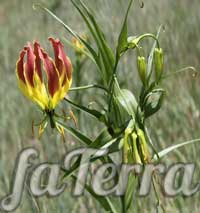 The area of widespread distribution is the clay soils of the rainforests and monsoon forests of the African continent.
The maximum height of the plant reaches three meters. Bright green, eight-centimeter leaves have an elongated lanceolate shape. Smooth, slightly wavy flowers appear in the axils of the leaves. Six unbent petals, five centimeters long, and several stamens form this unsurpassed beauty. The petals are greenish-yellow with a reddish tint on top, and the back is pale pink. It blooms in the summer.
Gloriosa rothschildiana
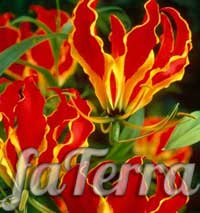 Native to Africa. A distinctive feature of this species is its large leaves, up to seventeen centimeters in length. With the onset of early spring and until late autumn, Gloriosa rothschildiana blooms. The curly petals are maroon, even red, on top, and completely yellow on the bottom. The flowers resemble bells.
Gloriosa lutea
 An evergreen, branched plant with green, lanceolate leaves. It can reach a height of two meters. Beautifully flowering gloriosa with yellow flowers has curved petals.
Gloriosa carson
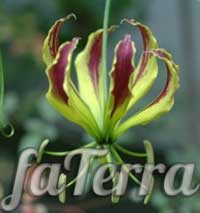 This variety is an evergreen, two-meter vine with thin and nodular stems. Lanceolate leaves with tendrils. Original flowers are purple-purple in color with light yellow curved petals.
Gloriosa care in the home
Indoor gloriosa flowers can be found more and more often in the apartments of residents and in office premises. And so that the climbing lily of glory delights with its beauty and originality, it is necessary to remember the nuances of its cultivation.
Sometimes they ask: why does the indoor lily not bloom? Although gloriosa is not a very whimsical plant, it must overwinter in a cool place. After shedding its leaves, the flame lily must rest and regain its strength in low temperatures. And then, from spring to late autumn, the beautiful gloriosa will have effective greenery and a wonderful display of abundant flowering.
Choosing a location and temperature regime
The southern beauty will feel comfortable on windows or near them, facing east and west. On a south-facing windowsill, it is necessary to shade the direct rays of the midday sun.
Why do the leaves of the lily turn yellow? To prevent this, it is necessary to protect the plant from drafts. The pot with gloriosa should be placed so that air currents do not blow on the flower, but there is maximum access to fresh air. Then there will be no reason for the plant to get sick and the leaves to turn yellow.
In the spring-summer period, maintain a temperature in the range of 18-25˚C. In winter, gloriosa rests at a low temperature of 10-15˚C, even down to 5˚C.
Air humidity and watering
Gloriosa needs high humidity, about 70%. Daily spraying with soft water at room temperature is recommended. You can place a small container of water next to the flower. An ideal option may be a self-watering flower pot.
From early spring, after the appearance of shoots, and until autumn, gloriosa is watered abundantly with soft, settled water. The soil mixture must be kept slightly moist. In autumn, when the plant prepares for a period of rest, watering is reduced. During the winter rest period, the bulbs are not watered.
Soil
The soil mixture should be nutritious with a neutral reaction. A self-prepared mixture should contain: garden soil, sand or perlite, peat or humus in equal proportions. It will also grow well in a universal soil mixture for indoor flowers.
Fertilizer
During the active growth period, the gloriosa flower must be regularly, at least twice a month, fed with liquid fertilizers for flowering plants, which contain potassium and phosphorus. Organic and mineral fertilizers will also not harm the plant.
Transplanting
Annual spring transplanting is essential for gloriosa. Prepared bulbs must be planted in a vertical position in a ceramic flat pot with dimensions: width - 35 cm, and height up to 25 cm. The soil should cover the bulbs by three centimeters. A good drainage layer is required at the bottom. Gloriosa will not bloom in large pots.
Reproduction
Gloriosa can be easily propagated by bulbs during transplanting. Small bulbs weighing more than ten grams are planted in fifteen-centimeter ceramic pots with the sprout upwards. The planting depth is up to three centimeters. They are kept at a temperature of at least 25˚C and in diffused light, and watering begins after the appearance of shoots.
Gloriosa from seeds will delight with its beautiful flowering only in the third year. The seeds, soaked in water, are sown in moist substrate to a depth of half a centimeter in ceramic pots. Create a mini-greenhouse environment with a temperature of 24-27˚C. It is necessary to ventilate and spray the soil daily. After 2-3 months, small plants will appear. When the third leaf grows, the seedlings are transplanted into separate eight-centimeter pots. The plant needs a ladder-shaped support to form a dense crown.
Gloriosa diseases and pests
Care for gloriosa, performed without errors, can protect the plant from pests that can cause it trouble. These can be scale insects and aphids. They must be treated with insecticides - actellik, carbophos, Aktara.
Problematic moments in growing the "lily of glory":
- The plant grows slowly and does not bloom - it is necessary to feed the flower with fertilizer containing phosphorus and potassium. Insufficient lighting, it is necessary to move the gloriosa to a brighter place or use fluorescent lamps.
- The leaves of the plant turn yellow and dry - the air temperature is too high, the humidity is low. Regular spraying and frequent watering are necessary.
- The leaves darken, wilt and curl, and the growth of young shoots slows down - sharp temperature changes, possible drafts.
- The shoots are covered with a white coating - too high humidity and overwatering of the soil.
The beautiful gloriosa is poisonous. The bulbs of the plant contain an alkaloid that poses a deadly danger to humans. Gloves must be used when handling and hands must be washed thoroughly.
A very beautiful and poisonous flower is clivia.
With scrupulous care and fulfillment of the basic requirements of cultivation, the flame lily will reward you with bright, luxurious flowering for several months.

Write comments
Comments