



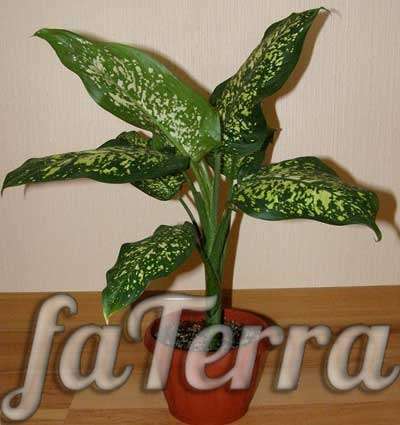
Latin name: Dieffenbachia
Category: evergreen shrubs, shrubs, perennial herbs
Native to: Southern and Central America
Impressive and adaptable Dieffenbachia
Dieffenbachia (Dieffenbachia) is a genus consisting of thirty species of picturesque evergreen shrubs and herbaceous root plants, belonging to the huge Araceae (Araceae) family.
No one will argue that the Dieffenbachia flower is the most common indoor plant. This green beauty can often be found in production facilities, supermarkets, hospitals, kindergartens, and it is also used to beautifully decorate living rooms, verandas, and balconies. Every flower lover wants to grow this miracle of indoor flora in their home.
What makes this flower so attractive to amateur gardeners?
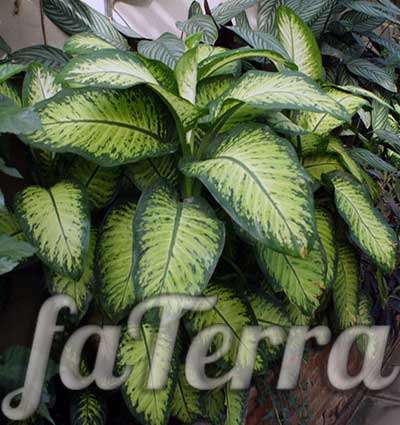
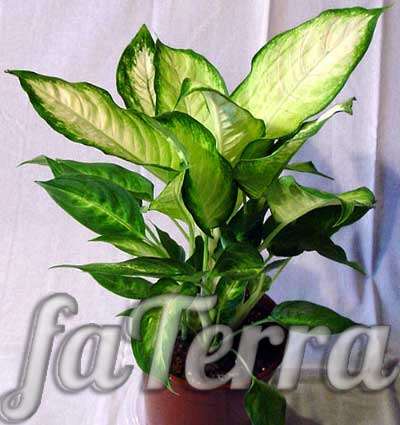
The lush and expressive Dieffenbachia has variegated, large leaves of an elongated and symmetrical shape, located on thick, juicy stems that resemble tree trunks.
The leaves are the decoration of the plant.
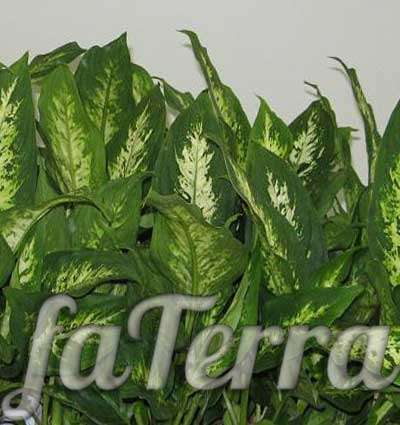
The unique charm, which is unparalleled in the plant world, is created by the amazing patterns on the leaves, painted with spots, dots, and stripes of various shades, from dark green to pure white. Flowering of Dieffenbachia in home conditions is almost impossible. Small, pale flowers, which are collected in dense inflorescences - spadices, can only be admired in the wild.
The native habitat of the Dieffenbachia plant is the tropical forest areas of Central and South America, where it is accustomed to shady conditions, but this does not prevent it from being a very light-loving flower.
This beautiful plant was discovered and described in the nineteenth century and named after the famous Austrian naturalist Heinrich Wilhelm Schott, in honor of Josef Dieffenbach - the head supervisor of the imperial botanical garden at Schönbrunn Palace in Vienna. Thus, the Victorian period was a period of prosperity for Dieffenbachia - an ornamental plant. This beauty appeared in our country and became popular a century later.
The closest relatives of Dieffenbachia are Syngonium and Zamioculcas.
Dieffenbachia species and varieties
Dieffenbachia maculata, also called Dieffenbachia picta
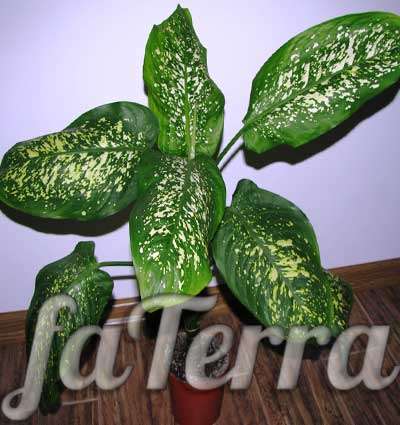
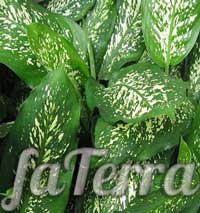 The most common decoration for residential premises, spacious halls, and corridors is the Dieffenbachia maculata. It forms one or more large stems that are decorated with oval, large glossy leaves up to half a meter long, and the width of these giants is 12 cm. Each variety of Dieffenbachia maculata has its own unique color and patterns on the leaves. The plant grows up to one meter in height.
Dieffenbachia Leopoldii
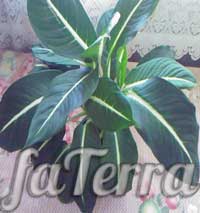 The native habitats of this species are Costa Rica. The delicate and tender Dieffenbachia Leopoldii has a short and juicy five-centimeter stem. Dark green, elliptical leaves with a light central vein are beautifully arranged symmetrically. The size of the leaves reaches up to 35 cm in length and up to 15 cm in width. They are attached to pale green petioles with bright green spots. With proper care, the plant will reward you with flowers, collected in an inflorescence up to nine centimeters in size, which is wrapped in a green-cream covering up to 17 cm long.
This type of Dieffenbachia can decorate not only a living room but also improve the landscape of courtyards and gardens.
Dieffenbachia Seguina
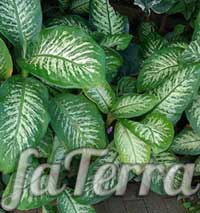 It came to us from the tropical humid forests of Brazil. The appearance is somewhat similar to Dieffenbachia maculata. The only difference is the shape of the leaves. They are wider and less variegated with spots.
The flowering Dieffenbachia Seguina forms a large, twenty-five-centimeter inflorescence.
Dieffenbachia Amoena
This has become the most popular species in home gardening. The external parameters are similar to Dieffenbachia Seguina, but it has significantly fewer leaves.
The stem of the plant reaches a height of one and a half meters. It is decorated with rounded leaves with a light pattern along the sides, resembling a Christmas tree. Thanks to this, Dieffenbachia Amoena looks very attractive and will decorate any interior, provided that there are no sudden temperature changes or drafts.
The spider mite also likes this species. Protect your beautiful plant from parasites.
Dieffenbachia Reflektor
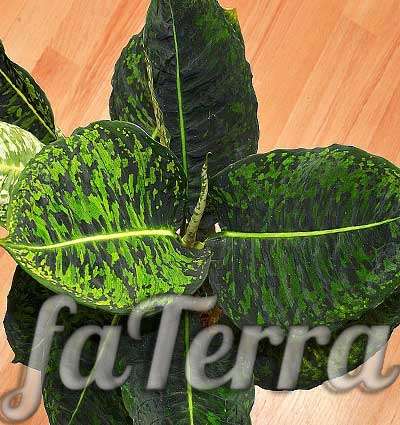
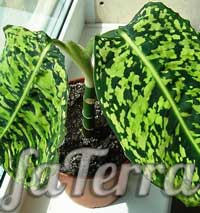 This is the most variegated species of Dieffenbachia. The plant has very beautiful, rounded leaves with pointed ends, dark green with a purple tint. They are covered with bright green or yellowish spots and have a distinct central vein.
Tropical forests are the most suitable natural conditions for this variety of Dieffenbachia. In home conditions, this forest beauty requires high humidity and moderate watering. The flower does not like hypothermia, but it is not afraid of direct sunlight within reasonable limits.
A similar flower in appearance is Marant.
Dieffenbachia bush. Based on Dieffenbachia maculata, breeders have developed various bush varieties and hybrids of the plant. They are all very beautiful and differ in size, shape, and unique patterns on the leaf blades.
Representatives of bush varieties of Dieffenbachia:
Dieffenbachia Camilla
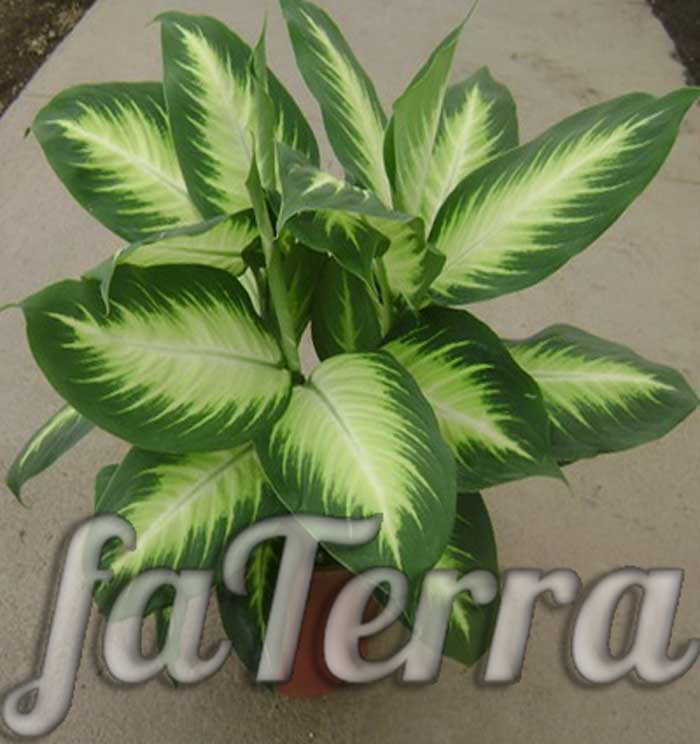
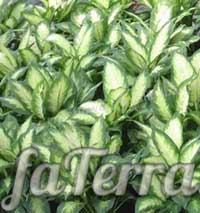 This is the most hardy bush variety, very popular among flower lovers. This plant has extremely beautiful lanceolate leaves of white-cream, green, or light shades. The edges of the leaves are framed by a dark green border.
Dieffenbachia Compakta
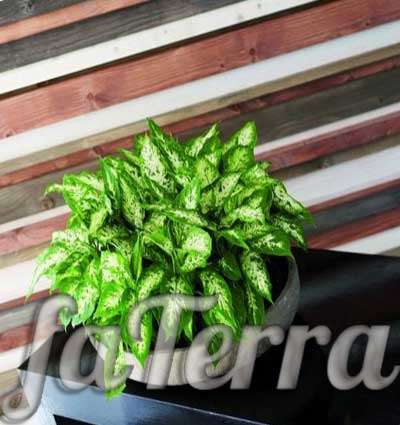
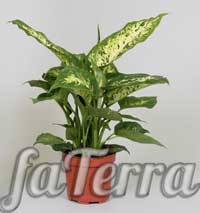 This is a miniature and neat bush variety. Its height does not exceed forty centimeters. The leaves along the central vein are covered with light dots.
Dieffenbachia care at home
Dieffenbachia is an unpretentious tropical plant. There are no special differences in the care of different types of Dieffenbachia. It is necessary to take into account all the nuances of cultivation and follow the general rules - water and spray in time, maintain a temperature regime, protect the plant from parasites. Everything is not difficult at all. And more details below.
Location and temperature regime
The light-loving Dieffenbachia needs a place with bright, diffused light, especially variegated varieties. This can be a window on the north-east or west side. Large specimens are best placed near a sunny window. If it is constantly dark in the room, it is necessary to use artificial lighting. With insufficient sunlight, the leaves become pale, the stems are stretched. The Dieffenbachia turns its leaves towards the sunlight. This is also done by Anthurium. The plant needs to be rotated periodically to avoid its one-sidedness.
The Dieffenbachia, which loves warmth, will feel great at room temperature in the summer (20-28°C) and in winter the temperature should not drop below 18°C. Protect the plant from drafts to avoid leaf dropping.
Watering and humidity
The plant needs to be watered abundantly with soft, settled water. A large amount of moisture evaporates from the large leaves of the Dieffenbachia, so it is necessary to replenish it and create a natural microclimate for your tropical queen. In the warm months, the flower should be watered at least three times a week, and every day it should be sprayed. In the cold season, watering should be reduced to one or two times a week. At the same time, it is necessary to monitor the condition of the soil, one-third of it should be dry.
The humidity level that is pleasant for Dieffenbachia is 55%. It is not necessary to spray the plant at low temperatures.
It is important to remember that too low humidity can have a detrimental effect on the condition of the flower.
Soil
The plant needs loose, nutritious, non-acidic soil that allows air to pass through. You can use ready-made soil from the store, or prepare the mixture yourself: one part of sand, peat, and garden soil, and two parts of leaf soil. Adding crushed charcoal or sphagnum will help prevent pests from getting into the soil.
Transplanting and feeding
The Dieffenbachia is transplanted as the root system fills the pot. Young Dieffenbachias need to be transplanted every year, and more mature plants every two or three years. The best time for this procedure is March or April, before the start of active growth. The pots for transplanting should be only one or two centimeters larger in diameter, so as not to stimulate excessive root growth instead of intensive growth of the above-ground part of the plant. Drainage is necessary and should occupy one-fourth of the entire pot.
Intensive feeding in the spring and summer months, once every two weeks, will only benefit the Dieffenbachia. You can use a universal water-soluble fertilizer. It is not necessary to fertilize the plant in winter.
Propagation of Dieffenbachia
It is not difficult to propagate the plant. Cut off the top of the plant and place it in water. When the roots grow to two centimeters, plant the plant in a pot and get a new beautiful Dieffenbachia.
The remaining stem is cut into cuttings 15-20 cm long, be sure to with a dormant bud. It is necessary to dry them and place them in water or in a peat-sand mixture. Small leaves will appear from the dormant bud. After the roots appear, these seedlings can be planted in separate pots.
Dieffenbachia: diseases and pests
The thick stem and large leaves of the Dieffenbachia can be a place for various pests. The plant can be affected by spider mites, scale insects, and mealybugs. After the appearance of uninvited guests, folk methods of struggle are used: a soap solution, an infusion of onion or lemon. The next stage of the fight will be the use of chemical preparations such as Decis, Aktellik, Fitoferm, Intavir according to the instructions.
Dieffenbachia care for it is not difficult, and the state of health of the southern beauty immediately shows mistakes in its cultivation.
Difficulties that may arise:
Dieffenbachia: superstitions
A common question is whether it is possible to keep a Dieffenbachia at home? There are two answers to this question. On the one hand, there is an opinion that the plant is a protector from evil and envious people. The presence of such people in the house can be neutralized by the Dieffenbachia. It is also said that the Dieffenbachia is a "male repellent".
On the other hand, there is an opinion that the Dieffenbachia absorbs oxygen and should not be kept in the bedroom. This is not true. There is scientific evidence that this beautiful plant cleans the air of xylenes, formaldehyde, and benzene.
From the above, it is clear that every flower lover must decide for himself whether to keep this amazing plant at home or not.
Dieffenbachia is poisonous. All parts of the plant are toxic. Do not allow the plant's sap to get on the skin or mucous membranes. Take precautions when caring for it, and everything will be fine.
After all, the Dieffenbachia is a very beautiful plant and deserves to decorate any room. Yatropha is also a poisonous plant.
Write comments
Comments