



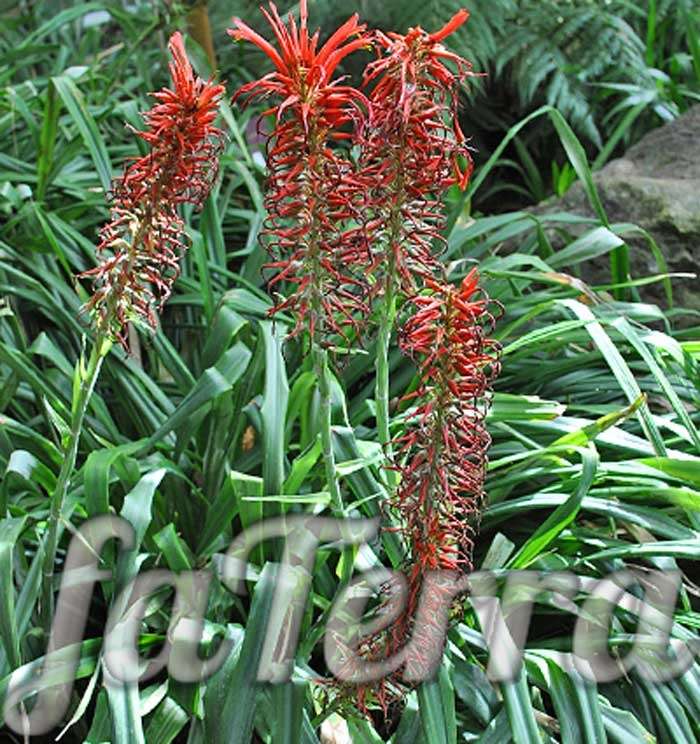
Latin name: Pitcairnia
Category: epiphytic herbaceous plants
Origin: Central and South America, West Africa
Interesting and unique Pitcairnia
The Bromeliaceae family includes interesting herbaceous, terrestrial, and epiphytic plants, grouped in the genus Pitcairnia, which comprises over 200 diverse species. Its distribution area is considered to be South America, especially near the Andes and the Guiana Highlands. West Africa is the homeland of the Pitcairnia fructosa.
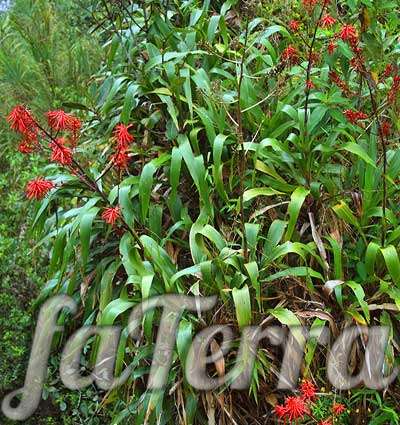
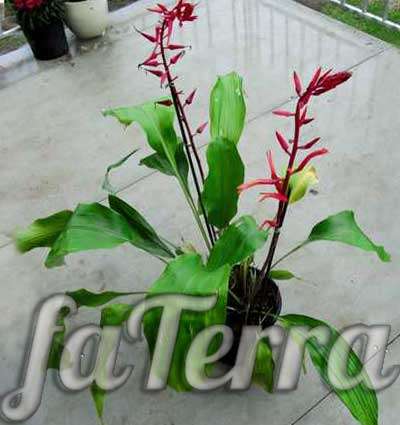
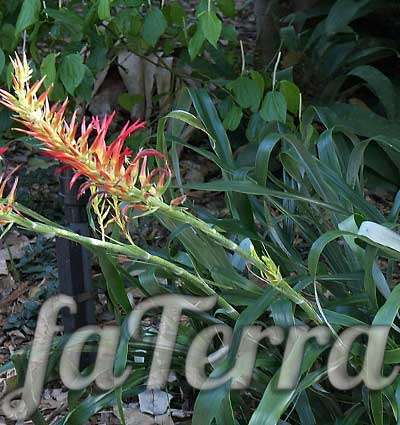
Very decorative, with a perennial growth cycle, the plants attract attention with their almost meter-long dark green leaves. They are gathered in large rosettes. Resembling a bunch, up to one meter long, the inflorescences are decorated with five-centimeter-long, funnel-shaped, shiny flowers of greenish-blue, red, white, blue, and green hues. After flowering, the plant withers, but several young rosettes grow near it.
The name Pitcairnia was given in 1788 by the French botanist Charles Louis Lheritier de Brutelle, who immortalized the name of the French naturalist William Pitcairn.
In European countries, Pitcairnia appeared as early as 1873, but in the individual collections of amateur flower growers, it is still a rare and valuable specimen, unlike its close relative Billbergia. Bright representatives of cultivated Pitcairnia species can be a decoration for any room.
Pitcairnia species
Pitcairnia andrea (Pitcairnia andreana)
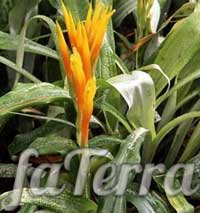 The native growing areas of this variety are considered to be the forests of Colombia.
Decorative Pitcairnia andrea will feel great and look great in greenhouses, saunas, spas, winter gardens, bathrooms - rooms with high humidity and very warm temperatures.
The few green, linear leaves of this terrestrial, twenty-centimeter shrub form a small petiole at the base. The sparsely flowering, brush-like, wide, scaly inflorescences are the decoration of Pitcairnia from March to August. In autumn, fruits in the form of a capsule appear on the plant.
Pitcairnia undulata (Pitcairnia undulata)
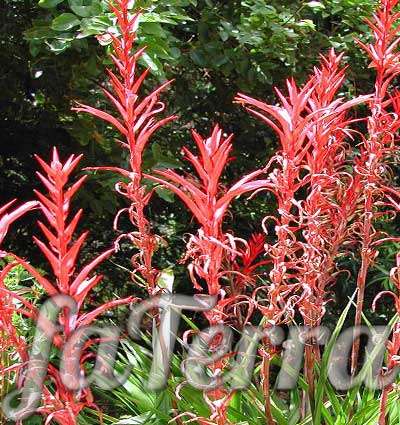
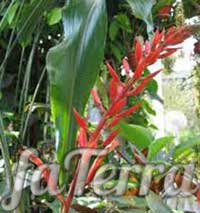 A herbaceous, perennial, stemless plant native to Brazil. Narrow, up to fifty centimeters long, triangular brown leaves form basal rosettes. A leafless, straight inflorescence holds loose, many-flowered, bright red inflorescences.
Pitcairnia maidifolia Decne
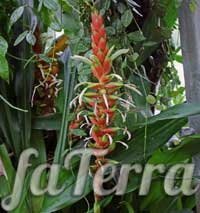 The center of the American continent, from Honduras to Colombia, is the native growing area of Pitcairnia maidifolia. A herbaceous perennial, its underground roots raise a one hundred and thirty centimeter rosette, which resembles a bunch. It consists of few, up to one meter long, sharp green leaves. The underside of the leaves has a silvery hue. The plant blooms from July to September. White-green flowers are gathered in inflorescences on straight inflorescences.
Pitcairnia flammed
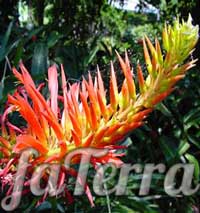 The distribution areas of this species are considered to be the granite rocky formations near Rio de Janeiro. Spring is the flowering period of this beautiful Pitcairnia. Red and white flowers beautifully decorate the mountains.
Pitcairnia aculeata
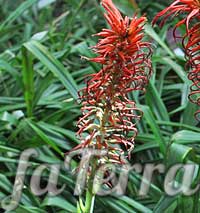 This species is native to northern Colombia and Venezuela. Here, at an altitude of about 1500 m above sea level, in open areas and rocky areas, there are terrestrial, almost one-meter-high, beautiful rosette plants that bloom in September.
Pitcairnia care in the home
Indoor Pitcairnias are very decorative, beautiful, and unique, especially when they bloom with red, white, green, or orange flowers and colorful bracts. They are hardy, friendly, and undemanding to the conditions of keeping. But, in order to have a charming flower in good condition, it is necessary to follow certain rules of its cultivation.
Choosing a place and lighting
The most suitable place for Pitcairnia will be east- or west-facing windowsills. Intense, bright, but slightly diffused light will be pleasant for the plant. In the morning and evening, direct sunlight is not harmful. On warm days, it is desirable to take the flower out into the fresh air.
Temperature
Sudden temperature changes are undesirable for the plant. Comfortable summer temperatures are 20-25°C, in the cold season 17-19°C, the lowest temperature is about 16°C.
Watering and air humidity
Pitcairnia should be watered abundantly in the warm season, and watering should be reduced in winter. It is desirable to keep the soil slightly moist. You can use self-watering pots.
The plant loves humid air. To maintain humidity at 60%, it is necessary to carry out regular, abundant spraying. You can use a small spray bottle. And the water should be soft and warm.
Soil and feeding
Light, fertile soil should have the following composition: sod, peat, leaf, humus soil, and sand. You can buy a soil mixture intended for bromeliads in a store. Drainage is essential.
For feeding in the summer, it is desirable to use organic fertilizers every fifteen days. You can use fertilizers intended for bromeliads or other indoor flowering plants. The dose should be reduced by half.
Transplanting and propagating Pitcairnia
The plant is repotted in spring in shallow pots. They should be slightly larger than the previous ones.
When propagating, seeds or young shoots are used. In the spring-summer period, the offspring that have reached a height of at least 15 cm and have formed well are separated from the bush, slightly dried, and planted in a separate pot. Spraying the young plant will accelerate its growth.
Pests and diseases
If the conditions of keeping are properly maintained, Pitcairnia will not get sick and will not be afraid of pests.
- Regular inspection of the plant can prevent the appearance of scale insects.
- If unwanted guests appear, they must be immediately combated with biological and chemical agents.
- Wipe with soap solution, treat with insecticides.
Write comments
Comments