




Category: perennial herbaceous plants
Family: Orchidaceae
Origin: subtropical and tropical regions of South and Central America
Oncidium orchid - an exotic queen of flowers from the tropics
Oncidiums are bright, attractive, perennial herbaceous plants belonging to the orchid family. This group includes over seven hundred species of plants that are quite different from each other. Most oncidiums are epiphytes, which prefer the trunks or branches of large plants, while some are lithophytes, preferring rocks, and others are terrestrial plants.
These beautiful exotics spread from the highlands, about three thousand meters above sea level, in South and Central America, Mexico, and India. Humid tropical forests, mountain cloud forests, and savannas with sharp seasonal and daily temperature changes are suitable for oncidiums.
The description of this beautiful genus was made in 1800 by the Swedish botanist Peter Olof Swartz.
Oncidium "dancing dolls" or "dancing ladies" is a popular name for the plant, as its flowers resemble a girl in a voluminous, lush skirt.
Oncidium orchids have spread rapidly and become very popular among flower lovers. This regal plant occupies a central place among indoor favorites and adorns the home greenhouse with its presence.
There is a huge variety of oncidium species, but they still have common characteristics. They belong to sympodial orchids and can be compared to a creeping vine. This horizontally growing marvel consists of a rhizome - modified stems with nodes and internodes, from which leaves and pseudobulbs grow, with numerous aerial root shoots. The plant has long, narrow leaves. In the fall, a tall, highly branched inflorescence appears from the leaf axils. It features a straight, branched, arc-shaped inflorescence, ranging in size from 10 cm to 5 m, with a huge number of zygomorphic flowers. The uniqueness and individuality of the flower lie in its appearance.
The perianth is the center of symmetry.
The sepals consist of three small, similarly sized sepals, and the petals are two beautiful flower petals and a third - a large, guitar-shaped lip - labellum, with a noticeable, complex-shaped outgrowth.
Thanks to this outgrowth, the Latin name of oncidium combines words from the Greek alphabet: "onkos" - bumps, swellings, tumors; "eidos" - specimens, species.
Oncidium species and hybrid varieties
Oncidium Papilio
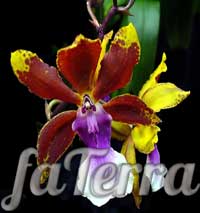 The most spectacular epiphytic orchid, whose native territory is the mountain forests of South America.
An unusual exotic with rounded, bright green pseudobulbs and leathery, greenish-olive leaves with red streaks. The base of the pseudobulb is the site from which a large, 60 cm to 1.5 m high inflorescence appears, which lasts for more than two years, with unusual, whimsical flowers of brown-red color appearing one after another in the fall. They resemble a butterfly with long antennae.
Oncidium tigrinum
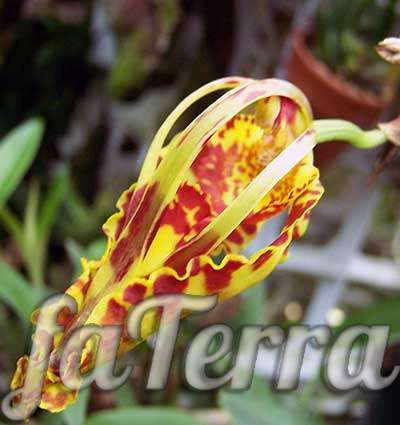
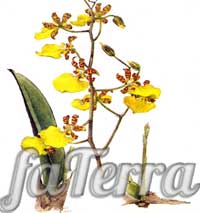 Tiger orchid is an epiphytic flower with two or three thick, woody, leathery, grayish-green leaves with purple spots above the oval-shaped pseudobulbs, which become a more vibrant brownish-purple with age. On a slightly branched, long, up to 80 cm high inflorescence, up to twenty bright yellow flowers with brown spots and a very large, lemon-yellow lip gradually bloom. Oncidium tigrinum blooms in early winter and adorns the interior with its unique, luxurious flowers for a month.
Oncidium yellow
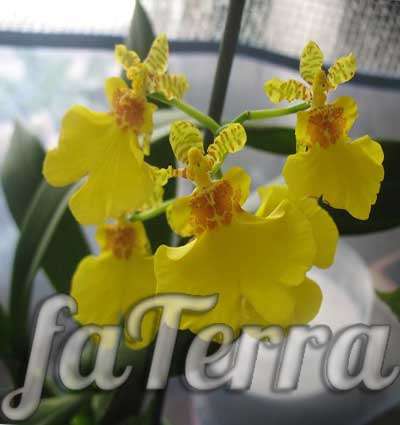
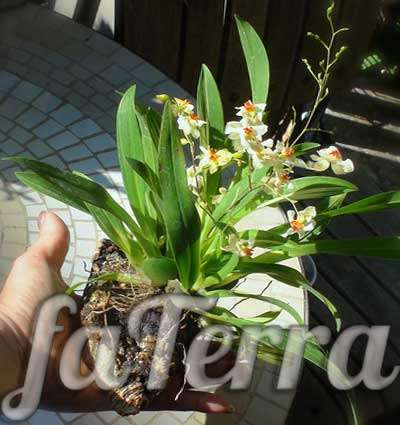
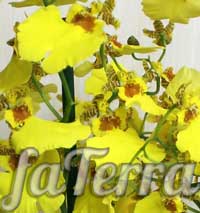 A profusely flowering and fast-growing variety of yellow oncidiums is very popular and suitable for growing in apartments. A large number of yellow flowers, up to 3 cm in size, with a lemon tint and a reddish spot on the lip, bloom simultaneously and adorn the branched inflorescence. The festive atmosphere created by the dancing doll lasts for more than a month.
Oncidium Sweet Sugar
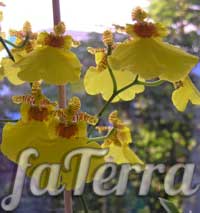 A common, unpretentious, compact hybrid with bright yellow flowers and a pleasant aroma, often found in indoor floriculture. It is loved for its fast growth and abundant flowering. This beauty will decorate any interior, lift the mood, and create a positive atmosphere. Even in cut form, bouquets will be beautiful for two weeks.
Oncidium Twinkle
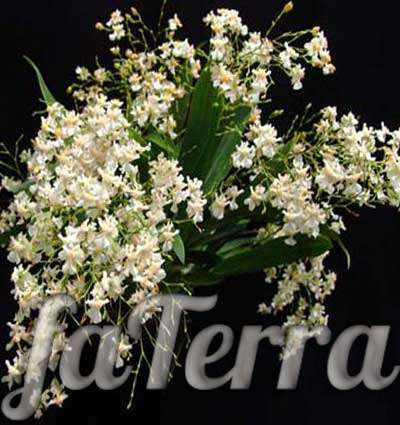
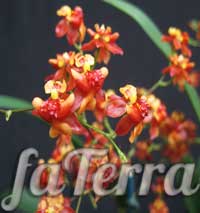 A miniature hybrid variety of oncidium, resistant to temperature fluctuations. Small pink, white, light yellow, reddish flowers of the Twinkle orchid, 1.5 cm in size, emit the aroma of fresh cinnamon rolls.
Oncidium lanceanum
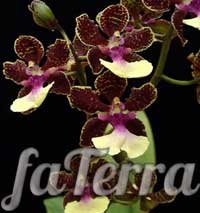 The most decorative species of oncidium orchid from the humid forests of the northeastern part of the South American continent. John Henry Lance found this plant in its natural environment in 1834, and it bears his name.
A tall epiphytic orchid with bright green, oval, rigid leaves with brown-red or purple spots. On a massive, slightly branched inflorescence, there are about twenty fragrant, greenish-yellow flowers.
Oncidium care in the home
Like all indoor potted plants, oncidiums require growing conditions similar to their natural habitat. To do this, it is first necessary to water the oncidium orchid correctly, provide a pleasant warmth, adequate lighting, and create a period of rest according to the rules. This can be achieved by gradually reducing watering and lowering the ambient temperature by 4-5°C. After three months, we reverse the process and soon get a flowering orchid.
Choosing a location
Light-loving oncidiums will not mind bright sunlight, but it is better to shade them during peak hours, and in the dark period, fluorescent lighting will only be beneficial, as orchids need bright light for 10-15 hours a day.
The flower should be placed on west- or east-facing windows.
Temperature
The optimal temperature range for the warm and bright oncidium orchid is 15-25°C. In the cold season, the temperature drops by five degrees.
Humidity and watering
Caring for oncidium orchids in the home involves maintaining moderate air humidity of about 50%, and up to 70% in hot weather. Regular spraying of the crown is desirable in the warm season.
Abundant watering is beneficial for oncidiums during flowering and active growth. Stagnation of water in the substrate should be avoided. Minimal watering in the cold season.
Soil and fertilization
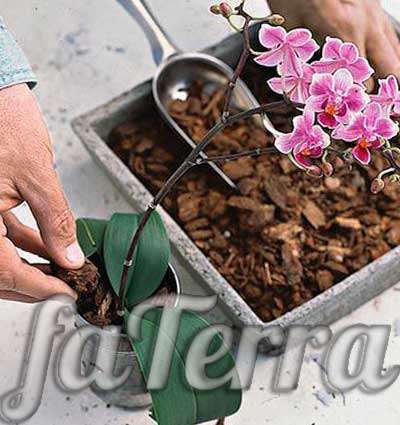
The basis of the substrate for oncidium is high-quality, carefully selected, and finely chopped pine bark, to which you can add fern roots, peat, or moss.
Oncidiums are fertilized with orchid fertilizers. Also, care for indoor flowers should include the mandatory procedure of feeding with solutions of mineral salts every three weeks. The main thing is to minimize the intake of nitrogen salts into the soil.
Repotting oncidium
Repotting is a difficult period in the life of a plant. The reasons for repotting the oncidium orchid may be: stopping the growth of the flower due to the too small size of the pot or the mismatch of the soil composition to the requirements of the plant. Dancing dolls need a tight plastic pot with a hole and good drainage to remove excess water from the roots of the queen of flowers in a timely manner, in order to protect it from a deadly danger.
Oncidium propagation
The easiest way to propagate oncidium is in the spring. To do this, divide the bush into parts with three shoots. Treat the cuts with crushed charcoal and plant each part in a separate pot.
It is not advisable to water the plant for a week.
Pests and diseases
Caring for oncidium is not very difficult, and the appearance of the plant immediately indicates mistakes and miscalculations in its cultivation. And if there are any, unexpected and dangerous guests may visit the flower. Most often, oncidium orchids are affected by aphids, scale insects, and spider mites.
If there are few pests, they can be collected by hand and treated with a soapy solution or a decoction of garlic or onion. If folk remedies do not help, immediately start treating with insecticides.
Difficulties that arise during cultivation
- Roots rot - excessive watering and drafts.
- Flower petals are covered with spots, stems and leaves rot - the substrate is too wet.
- The tips and edges of the leaves turn brown - low air humidity.
- The leaves turn pale green and are covered with small spots - excessive lighting, sunburn.
Love your orchid queen, and it will reward you with unparalleled beauty and abundant flowering.
Write comments
Comments