



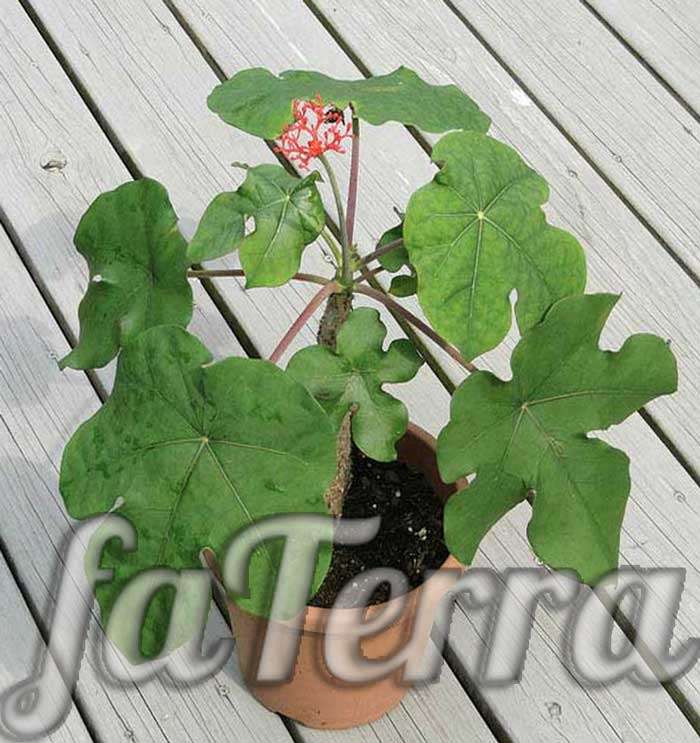
Latin name: Jatropha
Category: perennial succulent herbaceous plants, shrubs, trees
Native to: Central America
Interesting facts about the amazing, unusual, and undemanding Jatropha
Jatropha (Jatropha) is a very peculiar, leafy-decorative, and easy-to-grow plant of the Euphorbiaceae family. The beauty of this plant lies in its stem, which has the shape of a bulbous bottle - a source of water storage. This healing moisture is what the Jatropha flower feeds on during periods of drought. During this period, it sheds its few wide, lobed leaves, which are located on long shoots.
This makes sense. Jatropha is native to South and Central America. There are more than a hundred species growing in these regions. About twenty species are succulents. Perennial shrubs and trees of the Jatropha genus contain a milky sap that is very toxic. These plants grow, reproduce, and thrive mainly in areas with a tropical climate, in rocky areas and deserts, where there is a lack of water, as precipitation falls seasonally. Therefore, the thrifty succulents have amazing and diverse, sometimes even very bizarre configurations and shapes.
The origin of the name Jatropha is very interesting. In translation from the oldest language in the world, Greek, "jatrys" means "doctor," and "tropha" means "food," referring to the healing properties of some representatives of the genus, such as Jatropha curcas (more details below in the text).
Thanks to traders from Portugal, the original Jatropha was noticed and quickly spread from the Caribbean basin to Africa and Asia, where it found practical application as living fences.
Types of Jatropha that are especially beautiful, popular, and widespread
Jatropha multifida (Jatropha multifida)
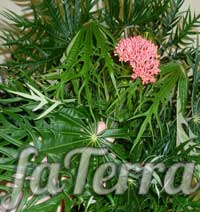 Low-growing shrubs that grow up to two or three meters in height, thrive in their native habitats in the Mexican United States (Mexico), Brazil, and Central America. The most interesting thing is that young Jatrophas look very much like small decorative palms. In nature, this beauty is covered with dark green leaves with a bluish tint, which reach thirty centimeters in diameter, with an original, divided into 8-11 parts. During growth, the leaves fall off, exposing the stem of the plant from below.
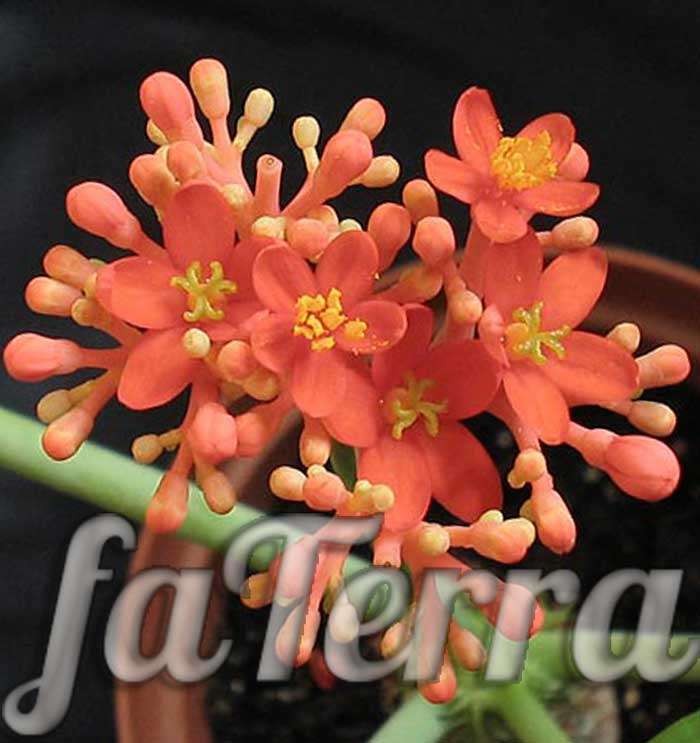
In the tropical native regions, Jatropha multifida adorns itself with flowers throughout the year, with the peak of beauty occurring during the hottest time. On long pedicels that appear from the growth point, inflorescences resembling umbrellas rise above the leaves, covered with bright red-coral flowers. The faded flowers turn into yellowish fruits that have a triangular configuration, about three centimeters in size. Inside, three oval brown nuts, about one centimeter in size, grow. The seeds of Jatropha multifida are dispersed by self-sowing and thus reproduce.
Jatropha multifida is sometimes called the coral tree.
The entire plant is very poisonous. Damaged parts of the Jatropha release a translucent sap that causes skin irritation.
Jatropha podagrica (Jatropha podagrica)
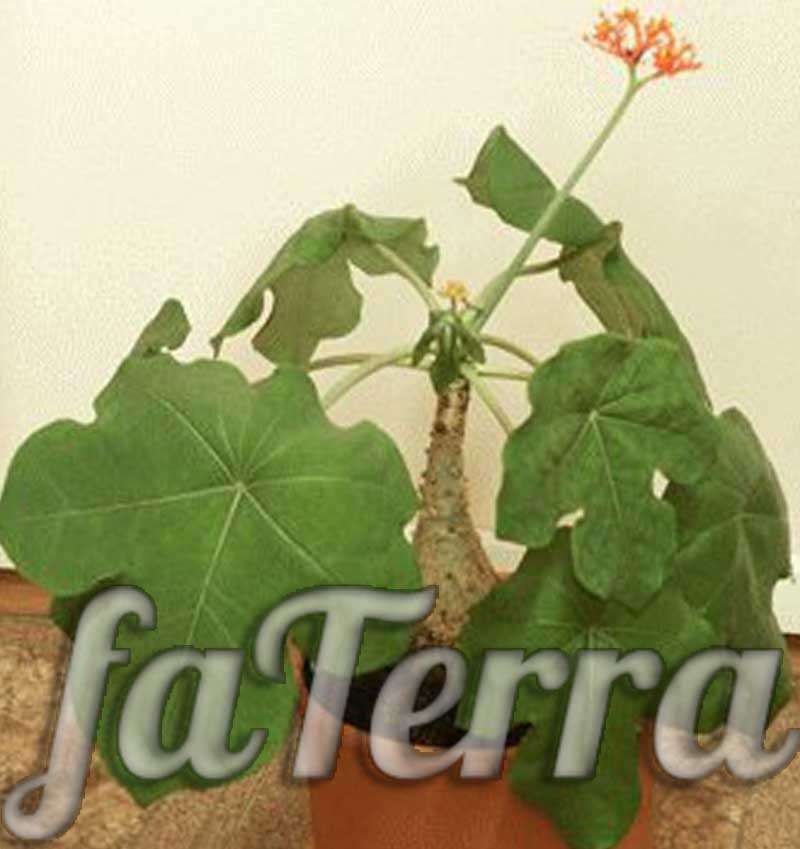
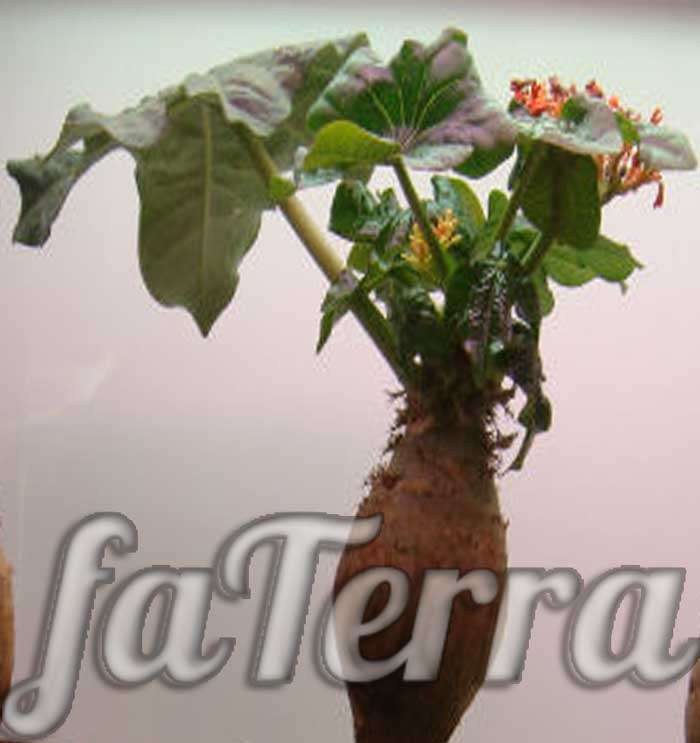
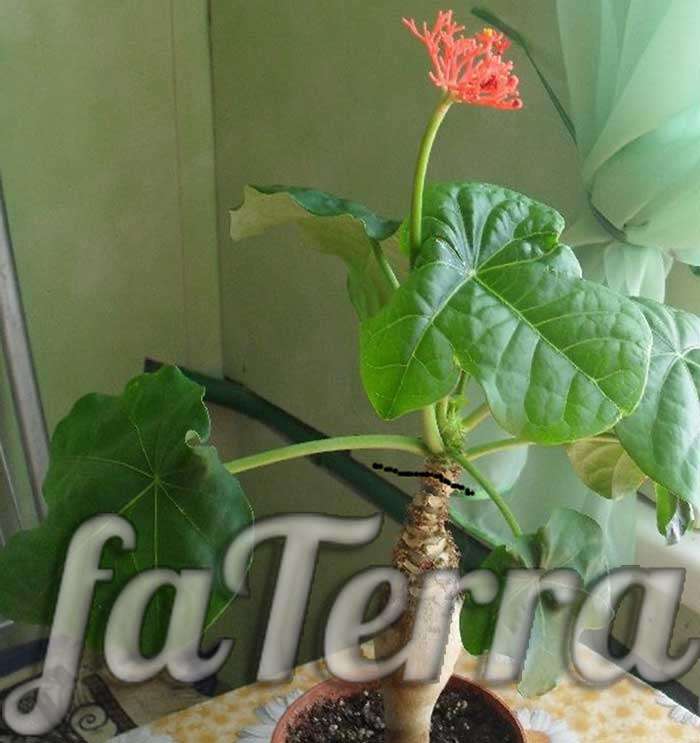
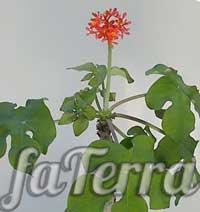 Jatropha podagrica is one of the most common, deciduous succulent, pachycaulous plants that form a caudex - a very thickened basal part of the stem. It absorbs moisture like a sponge and stores it for a long time. The native land of Jatropha podagrica is Central America, and today it has spread to the African continent and Asia.
The popularity of Jatropha podagrica was brought by the English botanist William Hooker, who described this wonderful plant in 1848. Since then, a separate species of Jatropha has appeared.
A very unusual, exotic shrub up to 70 cm high, with a growth pattern characteristic of rocky desert areas, where it is practically impossible to form a root system. In addition, Jatropha podagrica has another unusual feature: the petioles are attached not to the edges, but to the middle of the leaf blade. Unusual, rounded leaves that reach 15-20 cm in diameter change color depending on the age of the plant. Fresh, glossy, dark green leaves gradually lighten. In adult plants, the leaves have a dark color with an unusual matte tint, and the underside of the leaf is covered with a grayish coating. Red, inconspicuous flowers appear on adult Jatropha every spring, and in home conditions as well.
You can buy Jatropha and seeds in flower shops at any time of the year, where it is already sold with flowers.
In different countries, Jatropha podagrica has different peculiar names - "Buddha's belly," "Australian bottle plant."
When interacting with Jatropha podagrica, you need to be careful - the plant is poisonous.
Jatropha curcas (Jatropha Curcas)
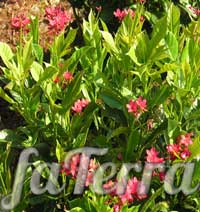 Jatropha curcas belongs to the Euphorbiaceae family and has other names - Barbados nut, physic nut. It is a very poisonous plant. Its natural habitat is Mexico, Central America, Asia, Africa, Hawaii, and South Florida.
Jatropha curcas shrubs grow up to six meters tall. Shiny green leaves are oval, pointed, and arranged alternately, with a heart-shaped base. Three- or five-lobed leaves grow up to six to forty centimeters long and six to thirty-five centimeters wide. Yellow flowers are collected in inflorescences, from which fruits in a three-lobed capsule develop.
So, these pleasant-tasting seeds have a terrible destructive power; they are very poisonous.
Nevertheless, this plant has found practical application in agriculture. The fruits of this shrub are very rich in oil, which contains up to forty percent. After a certain processing, the oil can be used as a biofuel. It has been tested in diesel engines. Flowers of Jatropha curcas are used to produce organic fertilizers and insecticides. It seems strange, but this poisonous plant is used to produce high-quality paper, balms, soaps, toothpastes, and cough remedies. Tobacco is moistened with preparations made from Jatropha curcas.
Jatropha lobata (Jatropha Lobada)
 The undemanding Jatropha lobata, also known as maple Jatropha, is a decorative shrub about 40 cm high. Toothed leaves have three or five lobes and are arranged on short petioles. Every spring, Jatropha blooms, forming a beautiful inflorescence that resembles an umbrella with red and orange flowers.
Jatropha care at home
Jatropha is a completely undemanding plant. To see your plant happy and vibrant every day, it is enough to follow some simple care rules.
The most important thing is to provide Jatropha with a period of dormancy.
Location and temperature regime
In the spring and summer, the location for Jatropha should be bright and warm, but without direct sunlight. During the dormant period, Jatropha sheds its leaves and does not require bright light.
The optimal temperature for Jatropha in summer is from twenty to twenty-five degrees, and in winter, it is desirable to maintain an air temperature of about fifteen degrees.
Air humidity and watering of Jatropha
Moderate air humidity is ideal for Jatropha. It tolerates dry air well, so frequent spraying is not necessary, but it is not superfluous to wipe the leaves with a damp cloth to remove dust. In winter, it is desirable to spray the soil in the pot.
Moderate watering as the top layer of soil dries out.
Watering Jatropha in winter is not necessary.
Propagation of Jatropha
Jatropha can be propagated by seeds and cuttings. Seeds are sown in soil, covered with glass, and kept at a temperature of about 25 degrees. Young shoots are transplanted into pots.
Jatropha is propagated by lignified cuttings at a temperature of 27-30 degrees. They need to be placed in a rooting box for a month. Ready cuttings with roots need to be transplanted into pots.
Transplanting
It is desirable to transplant Jatropha in the spring, every three years. Choose a low pot, slightly larger than the size of the previous one. The soil mixture should consist of equal parts of sand, peat, garden soil, and leaf soil. Good drainage is necessary.
Pests of Jatropha
To prevent thrips and spider mites from affecting Jatropha, avoid excessive dryness in the room.
How to avoid diseases of Jatropha?
- Rotting roots - excessive watering.
- Yellowing and leaf drop - possibly spider mites on the plant. Immediately rinse the plant with warm water and regularly spray it. If there are many pests, treat with insecticides.
- Flowers falling off - the plant is affected by thrips. Immediately place it under a warm shower and treat with insecticidal preparations.
- The plant grows very slowly - possible overfeeding with fertilizers. Fertilize Jatropha after abundant watering.
- Limp and faded leaves - low water temperature during watering. It is necessary to water the plant with slightly warm water.
Jatropha does not require special care. Just follow all the care methods that we have described above. As a result, your amazing Jatropha will bring you joy with its lushness and unique originality.
Write comments
Comments