



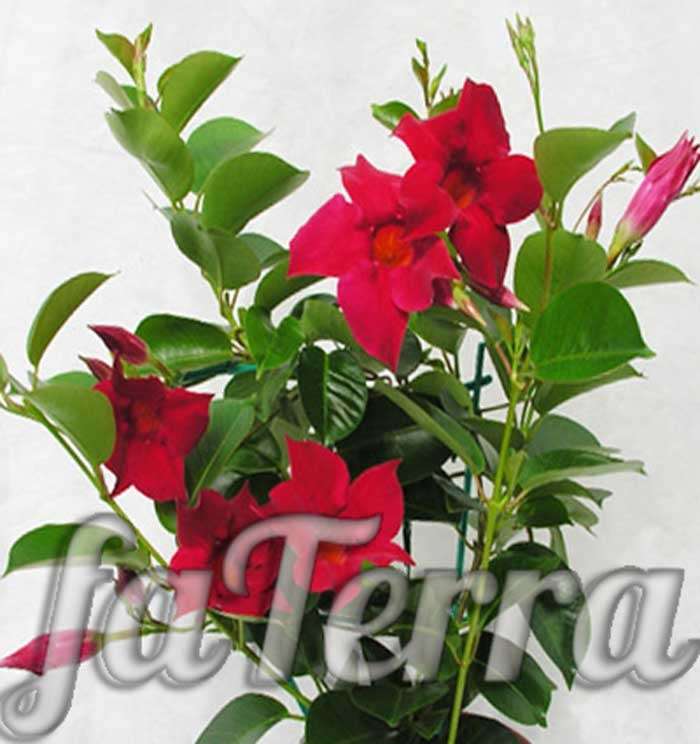
Latin name: Dipladenia
Category: perennial, herbaceous, evergreen vines
Native to: Southern and Central America
Dipladenia - a luxurious and beautiful, but demanding, queen of indoor vines
Dipladenia is a bright and elegant, profusely flowering vine, a representative of the Trumpet family. This wonderful genus has gathered under its umbrella about a hundred species of perennial and annual plants.
A very interesting feature is the existence of two different, but equally accepted, names in the plant world - Dipladenia Mandevilla. The solution is now quite simple. The first, a brightly flowering and beautiful plant, was found in the forest tropics of the South American continent. It was called dipladenia. In translation from Greek, this means approximately "having double glands (nectaries)." A little later, another plant was described in the territory of Argentina, which received the name Mandevilla. This discovery was directly related to the British diplomat and gardener Sir Henry John Mandeville. And only after some time, natural scientists recognized the same properties of these two genera. They were combined into one genus, and the synonym names still exist.
In different countries, the flower dipladenia is popular and has its own name. Some of the common names are: Mexican tree of love, Brazilian balsam, Chilean jasmine, Bolivian rose, Brazilian jasmine.
The native habitat of distribution can be considered the subtropical and tropical forest areas of South and Central America. Here they represent wild, curly semi-shrubs and shrubs with flexible and elegant branches.
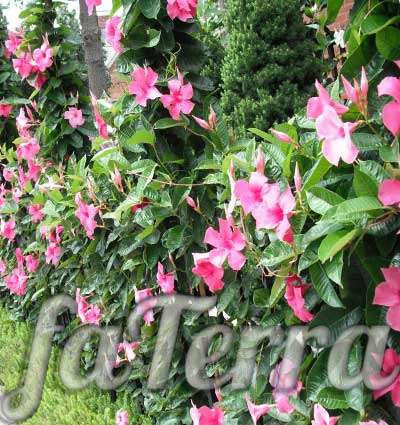
The plant dipladenia can be grown both in open and closed ground conditions. This vine will be a wonderful decoration of an open terrace, a gazebo, a gallery, a courtyard, wrapping them with its beauty and enchanting with its irresistible charm.
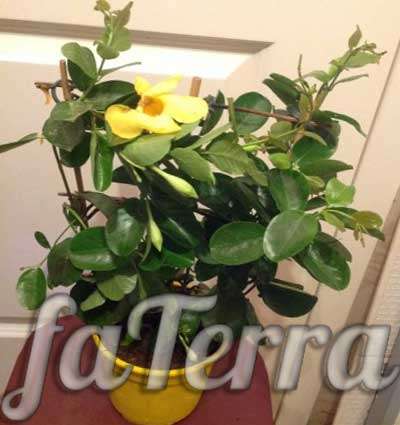
No less impressive will look a dipladenia pot, the Mexican tree of love, on a windowsill or balcony, possibly as an ampelous plant in a hanging pot. Indoors, it will look great both as a curly vine and as a compact bush. This is completely up to the personal desire of the florist, what kind of queen of dipladenia they want to see.
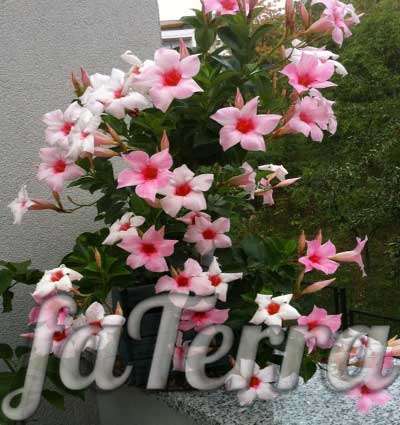
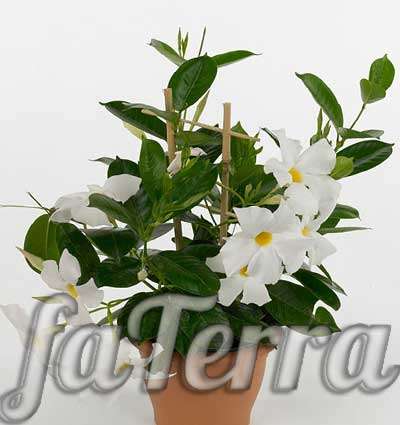
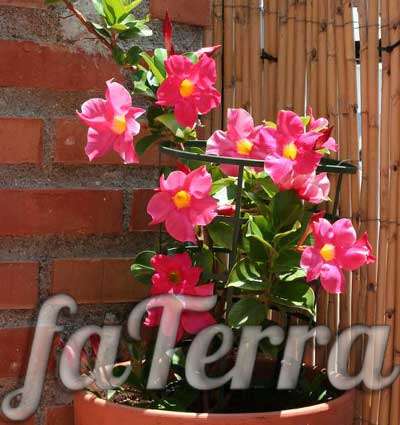
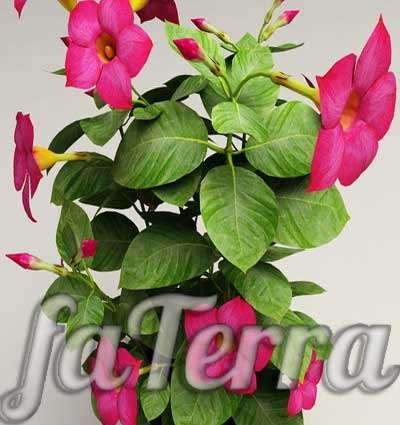
The elegant and noticeable beauty of dipladenia is manifested in the shiny, leathery, dark green, egg-shaped leaves with pointed tips, which are located on a curly, rapidly growing stem that reaches a length of four meters. And even more beautiful dipladenia looks in full bloom during the warm season. Five-petaled, funnel-shaped flowers grow up to 12 cm and abundantly cover the plant and spread a pleasant aroma. The diverse color palette of the charming dipladenia includes red, raspberry, white, and pink shades.
Growing dipladenia is quite difficult for beginner florists, but easier than growing azaleas or gardenias.
Dipladenia splendens
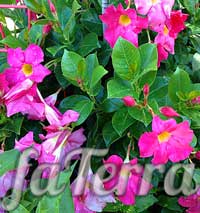 A flexible, evergreen plant. Most often found and looks beautiful as an ampelous plant. Young dipladenia stems are densely covered with large, up to 20 cm, opposite leaves. They have an oval shape, with pointed ends. With age, the number of leaves decreases, and the stems become exposed, reaching a length of up to four meters. The decoration of the plant is brightly pink flowers up to 10 cm in diameter, collected in inflorescences of 5-6 pieces.
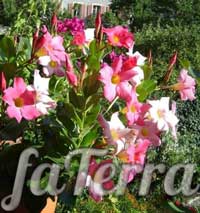 An exquisite, unsurpassed, brightly flowering, evergreen vine. On thin, flexible shoots, dense, glossy, five-centimeter, oval leaves with pointed ends are located. Beautiful bright pink flowers are collected in a beautiful company of five pieces in inflorescences. They decorate the queen of flowers throughout the warm season. Dipladenia has many varieties, but the most famous are "Rubiniana" and "Dark".
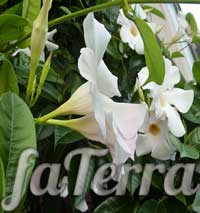 A room vine with smooth shoots. Small, green, glossy, oval-shaped leaves, about seven centimeters long, are located on them. Five-centimeter, fragrant, white flowers are located in groups of three or four on the peduncle.
In cultural horticulture, there are many popular hybrid varieties of dipladenia. Among them:
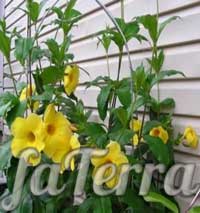 Allamanda and (Pentalinon luteum) Yellow.
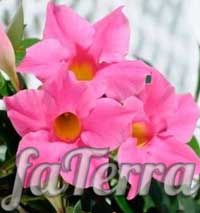 Amoena and Cosmos Pink, Super Duper.
Red dipladenia
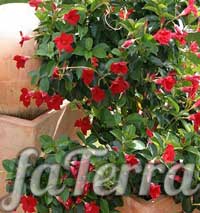 (Cosmos Crimson King) Cosmos Crimson King.
Caring for indoor plants at home is a pleasant, but also laborious, activity. The success of being able to enjoy the beauty of a tropical plant, dipladenia, requires the fulfillment of certain requirements: sufficient lighting, warmth, fresh air, a reliable support, appropriate temperature in the room, and regular pruning.
Choosing a location and comfortable temperature
First of all, dipladenia needs a lot of light. The exception may be direct sunlight. The best place for the plant is a window on the east side.
Fresh air is necessary for dipladenia, but without drafts.
The bright and heat-loving queen dipladenia is accustomed to warmth. It is well suited to a temperature range of 20-26°C.
The higher the air temperature, the more saturated and bright its flowers.
Watering and humidity
Monitor the humidity in the room and maintain it at a level of at least 70%. It is desirable to regularly spray the plant, and also place the pot with the flower in a tray with wet gravel.
Water the dipladenia abundantly in summer every 2-3 days, and in the cold season, reduce watering. Monitor the condition of the soil in the pot of dipladenia, it should be well-dried.
Soil
It will grow well in slightly acidic, loose soil. Soil mixture composition: peat soil, humus soil, coarse sand in equal proportions. Another option: one part of turf and peat soil, two parts of leaf soil and half as much sand or perlite. Good drainage is essential at the bottom of the pot.
Feeding
You can use a liquid fertilizer that is diluted by half. The procedure is carried out from spring to autumn no more than three times a month. It is permissible to feed the plant with complex fertilizers.
Transplanting
Annual spring transplanting into a larger and deeper pot, up to 25 cm, will only benefit the dipladenia. Young specimens, as they grow, and if necessary, are transplanted even twice a year. More mature plants can only change the top layer of soil.
Dipladenia pruning and propagation
Dipladenia is propagated in the spring by young stem cuttings, which are obtained during pruning. They are planted in a peat and perlite mixture. The seedlings need to provide greenhouse conditions with a temperature of about 25°C. After a month, rooted cuttings should be transplanted into pots. In the same year, the plant will delight with flowering.
Indoor plants dipladenia plant diseases
Most often, dipladenia can be affected by spider mites, scale insects, aphids, and powdery mildew. To prevent the attack of pests, regular inspection of the plant and maintaining a constant humidity in the room should be included in the care of dipladenia.
Difficulties that may arise in the process of growing:
- Dipladenia turns yellow and drops leaves - the temperature in the room is too low, the soil is over-watered, and in the summer period - too high temperature, direct sunlight falls on the plant, and the air in the room is too dry.
- Dipladenia does not bloom or blooms for a short time, small buds, pale leaf color - the plant lacks light.
- The leaves of dipladenia are drooping and the buds are falling off too quickly - lack of watering, dry air in the room.
- The plant grows slowly - insufficient nutrient soil.
- The roots are rotting - the soil is too over-watered and of poor quality.
It is always necessary to remember that this wonderful plant, dipladenia, is poisonousspathiphyllum
Write comments
Comments