



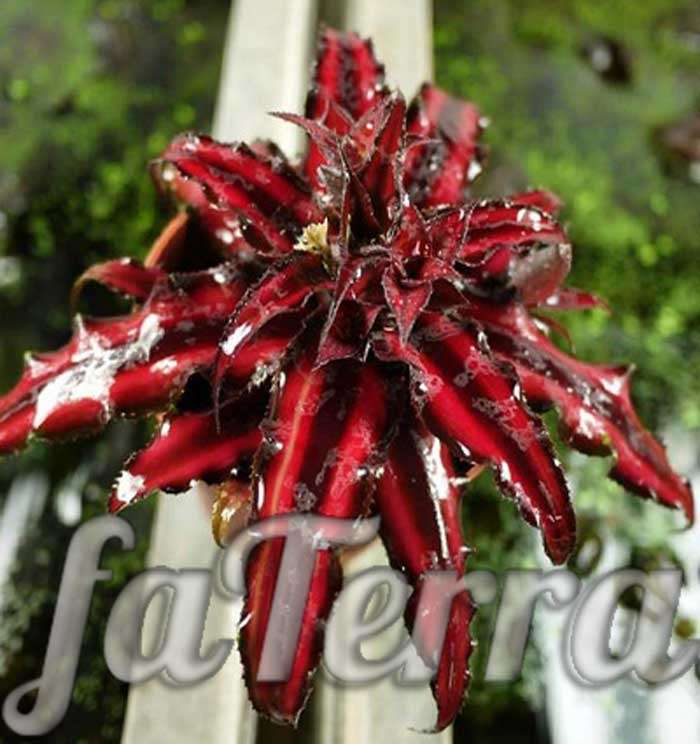
Latin name: Cryptanthus
Category: epiphytic herbaceous plants
Origin: tropics of South and Central America
Cryptanthus - the smallest "earth star"
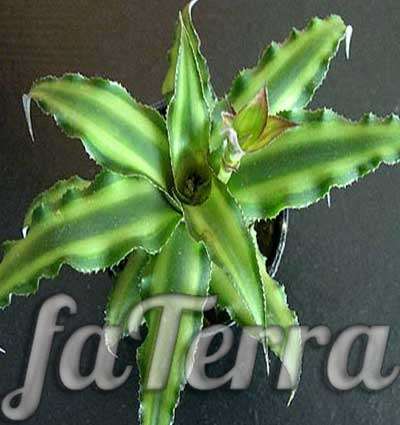
The botanical family Bromeliaceae includes the genus Cryptanthus, which has twenty-five varieties. Representatives of these exotics do not have stems. A large number of multi-colored, elongated leaves form tiny, open, and spectacular rosettes. Cryptanthus is a big fan of high humidity, just like its closest relatives in terms of care, Guzmania and Vriesea.
The native places of Cryptanthus are considered to be the tropical jungles of Brazil. This wonderful plant was discovered at the end of the nineteenth century and immediately appeared in European botanical gardens and terrariums.
The name of the flower, translated from Greek, means: crypto - to hide, anthos - flower, which means "hidden flower", which sounds plausible. After all, at first glance, the flowers, which are covered with leaves, are completely invisible. Cryptanthus is often called the "earth star".
Cryptanthus species
Cryptanthus acaulis
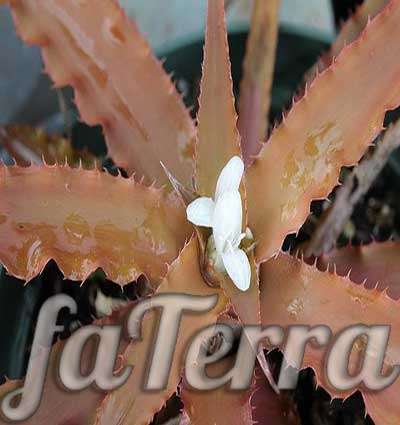
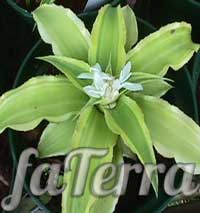 A perennial Brazilian stemless herbaceous flower. The unusual shape of the plant is given by the narrow lanceolate shape of the leaf plates. The length of the green leaves reaches twenty centimeters. They are slightly pointed at the top, the edges are serrated, and the underside of the leaf is covered with scales. 15 beautiful leaves form a star-shaped rosette, in which small white, rare flowers are hidden, collected in inflorescences, framed by wide oval bracts.
Cryptanthus bivittatus
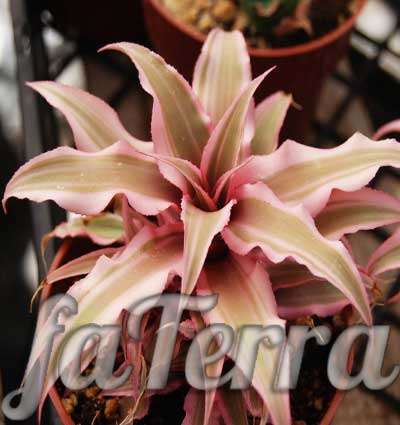
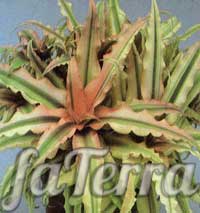 Characteristic of Cryptanthus bivittatus is a perennial life cycle and a herbaceous form of vegetation. Beautiful ten-centimeter light green, serrated and wavy leaves are decorated with two longitudinal stripes. They are collected in a dense miniature rosette, the diameter of which is fifteen centimeters. Sometimes the plant blooms with very inconspicuous white flowers.
Cryptanthus zonatus
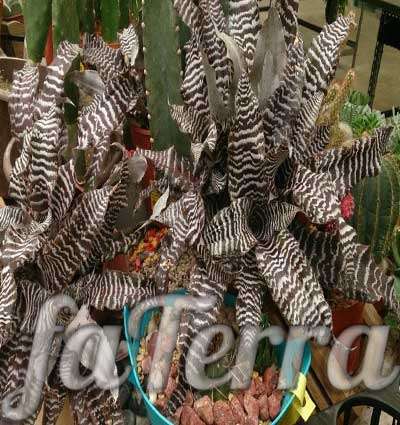
 A sprawling rosette is composed of lanceolate leathery leaves up to 20 cm long and up to 3 cm wide. And they attract attention with their unusual transverse pattern, which is created by a large number of whitish and yellowish fluffy plates. The few white, three-centimeter flowers form a complex, head-like, spike-shaped inflorescence.
Cryptanthus Fosterianus
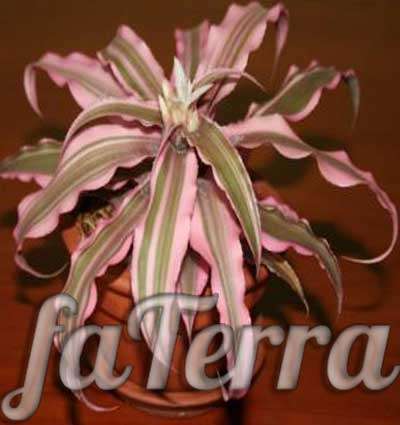
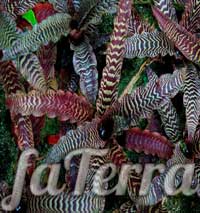 A perennial exotic native to eastern Brazil. It is similar to Cryptanthus zonatus. The distinctive feature is longer, up to 40 cm and narrower, up to 4 cm leaves. Very colorful, with wavy edges, reddish-brown leaves in a zigzag stripe with a silvery tint, the underside of which is scaly, form a charming rosette. Flowering Cryptanthus forms a complex, head-shaped inflorescence with outer four-flowered and inner two-flowered spikes of white color.
Cryptanthus bromeliodes
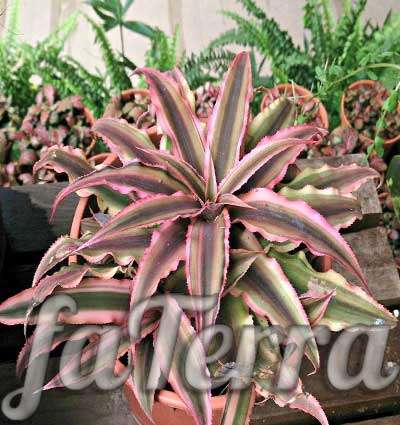
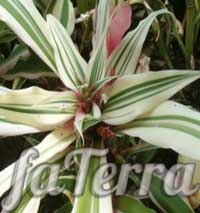 This species is distinguished by the presence of a stem, dressed in hard, wavy leaves with serrated edges. The color ranges from green-bronze to reddish-brown. The upper side of the leaf is smooth, and the lower side is scaly. The inflorescence, resembling an ear, is decorated with small linear white flowers.
Cryptanthus care at home
For the unpretentious Cryptanthus, the best place to live, in addition to its natural habitat, can be a botanical garden, terrarium, or a warm greenhouse. It will feel great even at home with inexperienced flower growers. And for this, it is necessary to provide normal care and fulfill the growing conditions.
Choosing a place
Bright areas with bright, diffused lighting are pleasant for the "earth star". It will have a beautiful contrasting leaf color on east, west, and south-facing windowsills.
Temperature regime
Approximately constant air temperature of about 18-25˚C, and in the cold season, up to 15˚C. Regular ventilation is desirable, avoid drafts.
Watering and air humidity
The dry upper layer of the soil signals the need for abundant watering of the "earth star" in the warm season. In winter, we keep the soil in a moist state. Unlike its relative, Echmea, Cryptanthus does not need to pour water into the rosette. Stagnation of water in the tray is not allowed.
The humidity in the atmosphere should be about 60% for the comfortable maintenance of Cryptanthus. We achieve this by regular spraying. The water should be soft and warm. It is not necessary to wipe the leaves.
Substrate and its feeding
Nutrient and fertile soil for bromeliads can be easily purchased in a store. It is not difficult to prepare the soil mixture with your own hands. Its composition: pre-crushed pine bark, peat, leaf soil, sphagnum, humus (3: 1: 1: 1: 0.5). One-third of the height of the pot should be drainage.
During the active growing season, the "earth star" desires monthly feeding with soluble fertilizers that have a small amount of nitrogen and do not contain calcium at all.
Transplanting and propagating Cryptanthus
There are no major difficulties with transplanting Cryptanthus. The plant has small roots, and due to its slow growth, it needs to be transplanted very rarely in wide and low pots. Flowering specimens are transplanted annually.
It is easy to propagate the "earth star" with offshoots-babies when they reach a height of 20 cm. It is necessary to separate the baby from the bush and plant it in fertile soil, be sure to spray it.
You can also grow a beautiful flower from seeds. The seeds are sown in a mixture of sand and peat, creating mini-greenhouse conditions, maintaining high humidity and high temperature. Seedlings with 3-4 leaves are piked and transplanted into separate pots in a permanent place.
Diseases and pests
By regularly inspecting your exotic pet, you can avoid the appearance of insect pests on Cryptanthus. If spider mites, whiteflies, mealybugs, or scale insects appear on the plant, immediately treat it with a soap solution, and if necessary, use insecticides.
Difficulties that arise in the process of growing:
- The leaves are covered with pale brown spots - direct sunlight fell on the plant.
- The ends of the leaves become dry - the air in the room is too dry.
- Lethargy of the leaves of the exotic indicates a lack of moisture or overwatering of the soil. It is necessary to urgently find out the reason and solve the problem in order not to lose your pet.
- Pale leaves can be caused by a lack of lighting.
- Rotting of the rosette can be caused by excessive watering, low temperature, and the presence of drafts.
- The quality of care will affect the excellent well-being of Cryptanthus and its wonderful appearance.
Write comments
Comments